


Annual report for the 2025 to 2026 fiscal year: Evolving to serve you better

Message from the Chairperson
The Social Security Tribunal (SST) works across Canada, including on traditional Indigenous territories. As part of our continued commitment to reconciliation, I want to share my respect and gratitude for the land we’re on and the peoples who have cared for it for generations.
This year, the SST heard over 6,000 appeals about Employment Insurance (EI), Canada Pension Plan (CPP) and Old Age Security (OAS) benefits, with appeals from every province and territory. We scheduled hearings promptly—including in-person hearings if that’s what the appellant wanted. We provided guidance to self-represented parties throughout the appeal process. We issued decisions soon after hearings. With efficient processes and a strong complement of members, we have no backlog of appeals.
Our mandate has expanded to include appeals about the Canada Disability Benefit (CDB), which began in July 2025. Anyone who disagrees with Service Canada’s reconsideration decision about the CDB can now appeal to the SST. We’re ready to hear this new type of appeal.
Throughout the year, we prepared for structural changes coming to the EI appeal process. As of April 1, 2026, first level appeals are heard by the EI Board of Appeal instead of our General Division. Second level appeals still come to our Appeal Division, but this is now a direct right of appeal—people no longer need permission to appeal to the Appeal Division. To get ready for these changes, we developed new processes, trained our members and staff, and updated our website, our case management system and the SST Rules of Procedure opens a new window. As usual, we consulted stakeholders along the way.
Read on to learn more about the 2025 to 2026 fiscal year at the SST. You can:
- take a Deeper dive into our work and the issues we deal with
- review our Key initiatives including the development of My SST Portal opens a new window for e-filing and managing appeal documents
- read summaries of significant appeal decisions in our Decision highlights
- browse detailed statistics for our Income Security and EI appeals.
In the coming year, we’ll maintain our focus on timely decision-making and people-centred justice.

Shirley Netten
Chairperson
Social Security Tribunal
Year at a glance
Text version
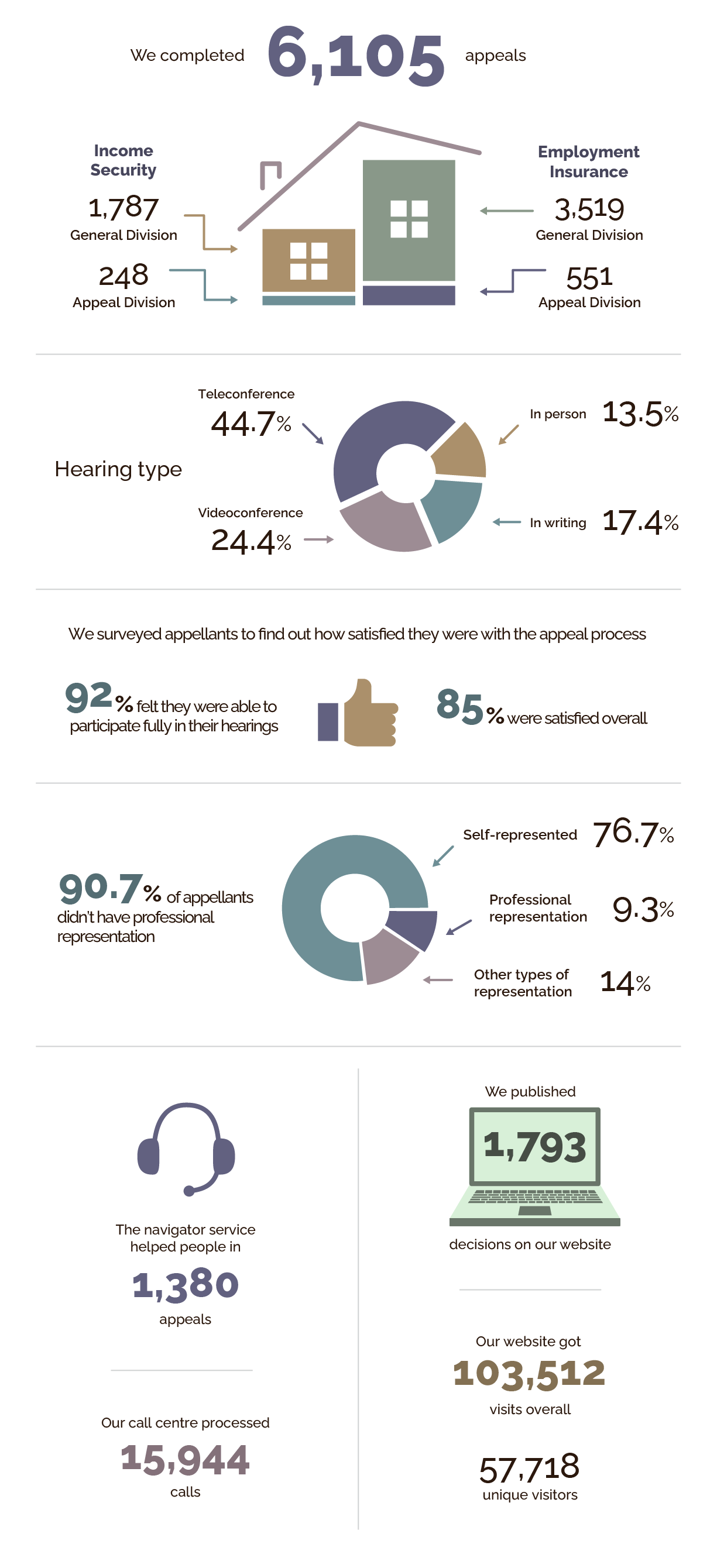
We completed 6,105 appeals.
- Income Security
- General Division 1,787
- Appeal Division 248
- Employment Insurance
- General Division 3,519
- Appeal Division 551
Hearing type
- 44.7% by teleconference
- 24.4% by videoconference
- 17.4% in writing
- 13.5% in person
We surveyed appellants to find out how satisfied they were with the appeal process.
- 92% felt they were able to participate fully in their hearings.
- 85% were satisfied overall.
90.7% of appellants didn’t have professional representation.
- Self-represented: 76.7%
- Other types of representation: 14.0%
- Professional representation: 9.3%
- The navigator service helped people in 1,380 appeals.
- The call centre processed 15,944 calls.
- We published 1,793 decisions opens a new window on our website.
- Our website got 103,512 visits overall (57,718 unique visitors).
Text version
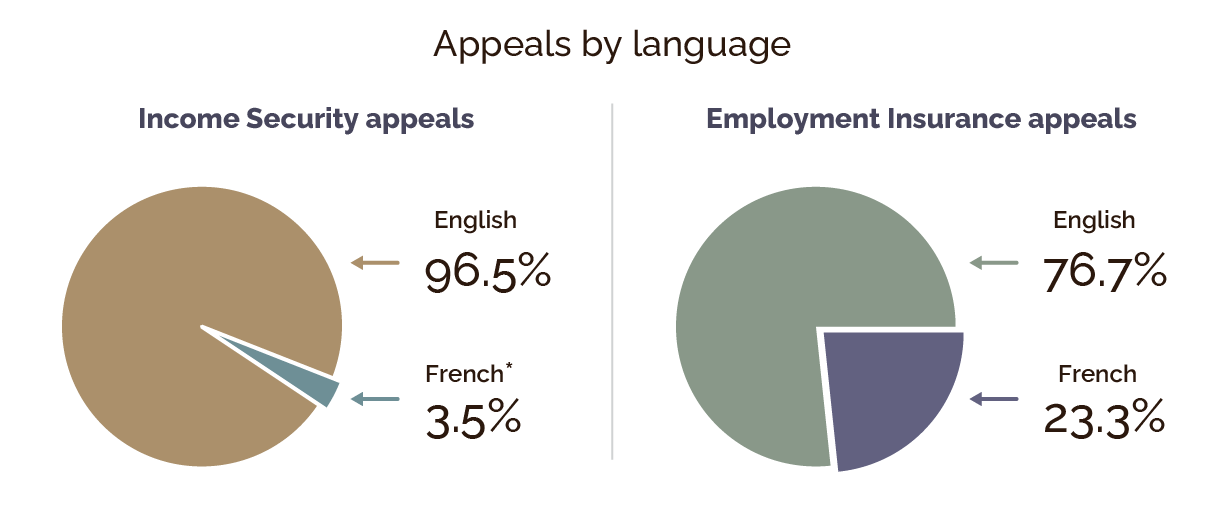
Appeals by language:
Income Security appeals
- 96.5% in English
- 3.5% in French*
Employment Insurance appeals
- 76.7% in English
- 23.3% in French
*Income Security appeals include CPP appeals but not Quebec Pension Plan appeals. Those appeals are heard by a tribunal in Quebec.
Text version
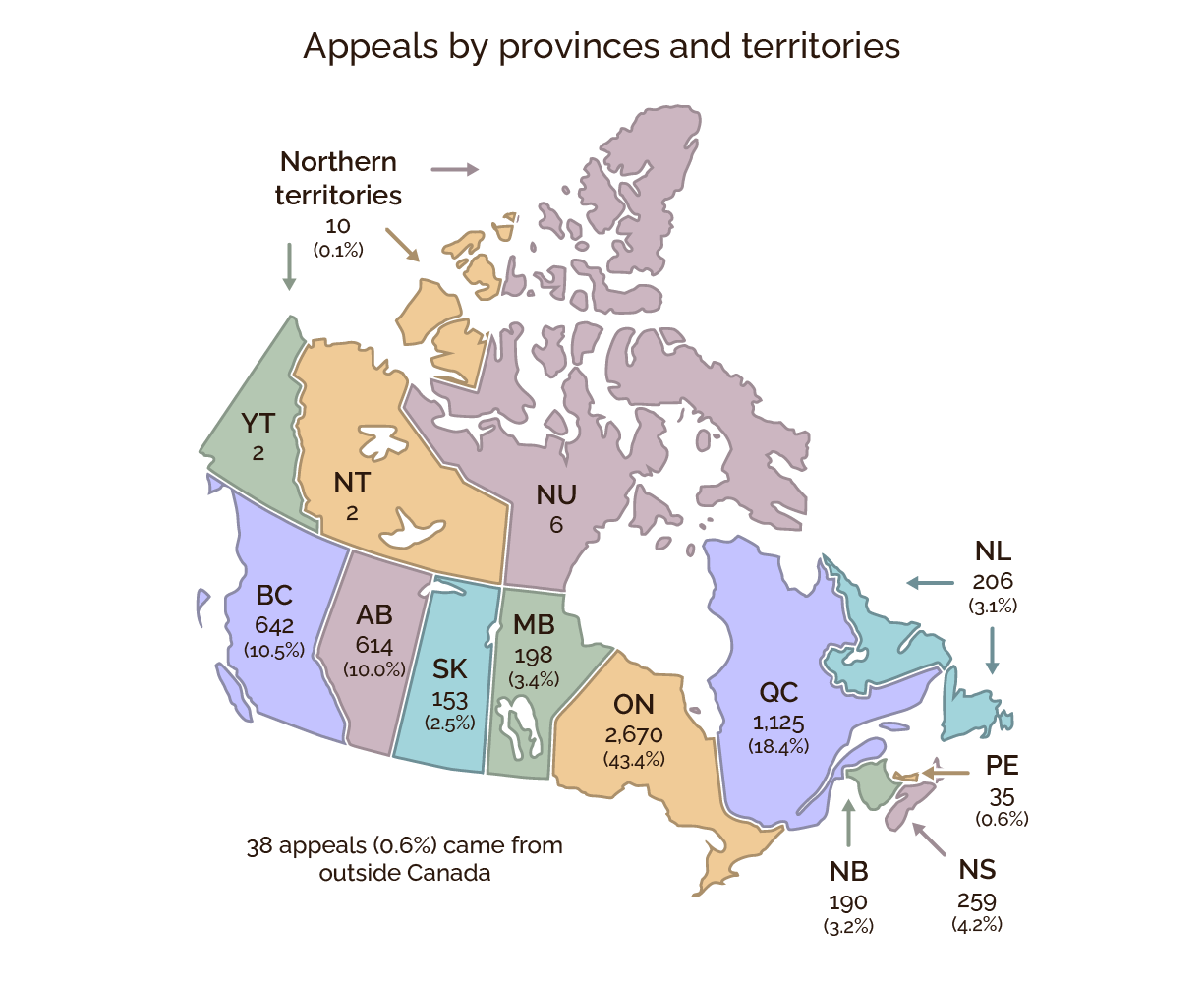
Appeals by provinces and territories
- 642 in British Columbia (10.5%)
- 614 in Alberta (10.0%)
- 153 in Saskatchewan (2.5%)
- 198 in Manitoba (3.4%)
- 2,670 in Ontario (43.4%)
- 1,125 in Quebec (18.4%)
- 190 in New Brunswick (3.2%)
- 259 in Nova Scotia (4.2%)
- 35 in Prince Edward Island (0.6%)
- 206 in Newfoundland and Labrador (3.1%)
- 10 in the northern territories (0.1% – Northwest Territories 2, Nunavut 6, Yukon 2)
38 appeals (0.6%) came from outside Canada
About us
Our work
People can come to the SST to challenge a government decision about their benefits.
We hear appeals related to:
- Canada Pension Plan (CPP) disability and other CPP benefits
- Old Age Security (OAS) benefits, including the Guaranteed Income Supplement (GIS)
- the Canada Disability Benefit (CDB)
- Employment Insurance (EI) benefits
The SST has two levels of decision-making: the General Division and the Appeal Division.
Our people
The SST is led by a chairperson and three vice-chairpersons. At the end of the 2025 to 2026 fiscal year, we had 64 members.
Our Secretariat is part of the Administrative Tribunals Support Service of Canada (ATSSC) and has 175 employees supporting our operations. The Secretariat, led by an executive director, provides registry, legal, outreach, evaluation, and administrative services.
The SST works independently from the Government of Canada. We don’t work for Employment and Social Development Canada, Service Canada, or the Canada Employment Insurance Commission. Learn more about how we work within government.
Deeper dives: behind our work
Spotlight on the General Division, EI Section
This was the last full year of operations for the General Division’s EI Section. Our members and registry worked diligently to ensure appeals were heard fairly and quickly. As a result, there’s a manageable inventory of open appeals for the EI Section to hear during the upcoming transition period. Here are some highlights:
Text version
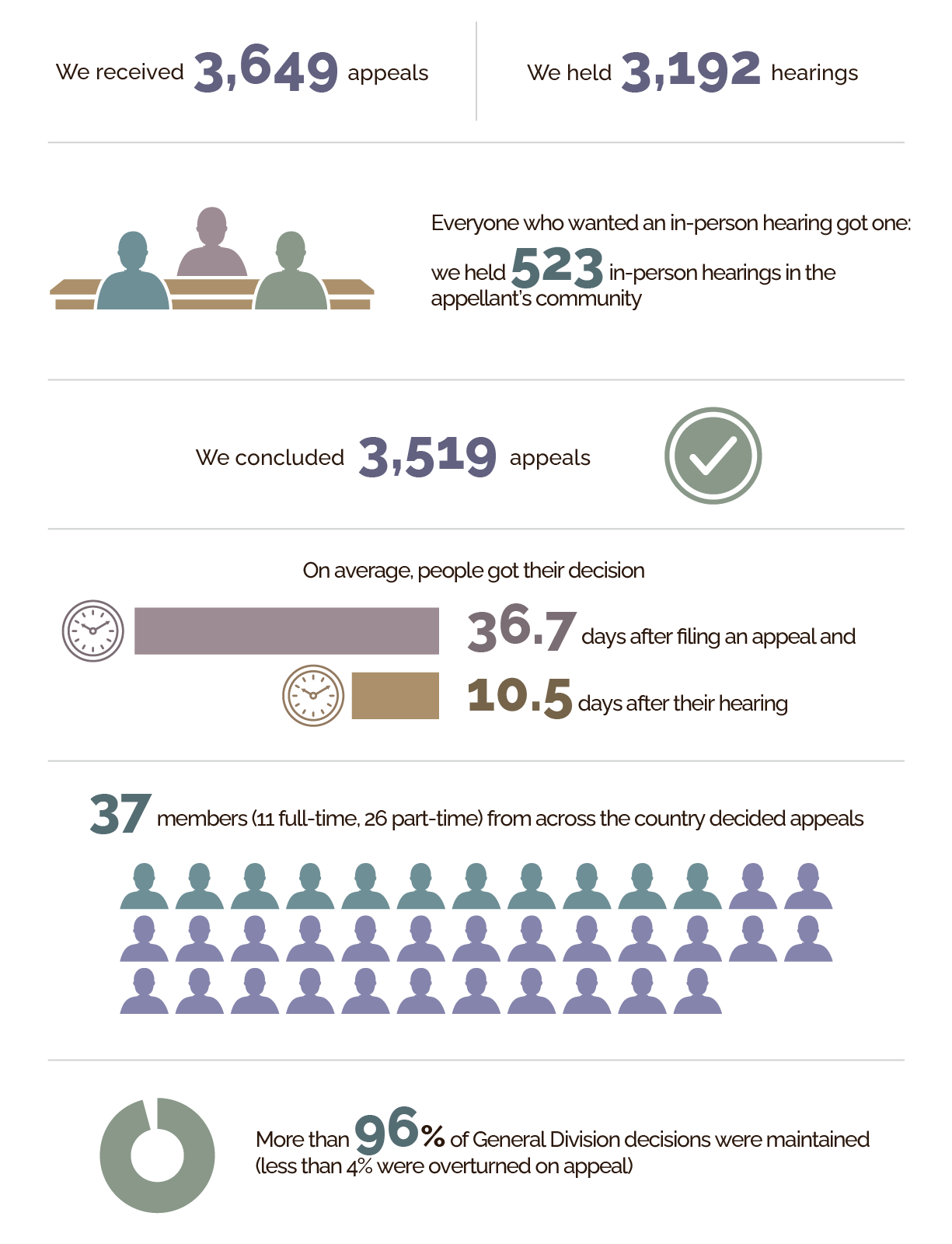
- We received 3,649 appeals
- We held 3,192 hearings
- Everyone who wanted an in-person hearing got one: we held 523 in-person hearings in the appellant’s community
- We concluded 3,519 appeals
- On average, people got their decision 36.7 days after filing an appeal and 10.5 days after their hearing
- 37 members (11 full-time, 26 part-time) from across the country decided appeals
- More than 96% of General Division decisions were maintained (less than 4% were overturned on appeal)
The most commonly appealed issues were:
- Whether the person should be disqualified from EI because they lost their job due to misconduct or quit their job without just cause (32%)
- Whether the person was available for work or making reasonable efforts to find work (20%)
- The number of weeks or specific dates that the person gets EI (their benefit period) (15%)
- Whether and when earnings (like vacation pay or severance) are deducted from EI benefits (11%)
A closer look at Income Security appeals at the SST
While most Income Security appeals are about a person’s eligibility for the CPP disability pension, we hear appeals on many other issues. Here are the issues our General Division, Income Security section dealt with this year:
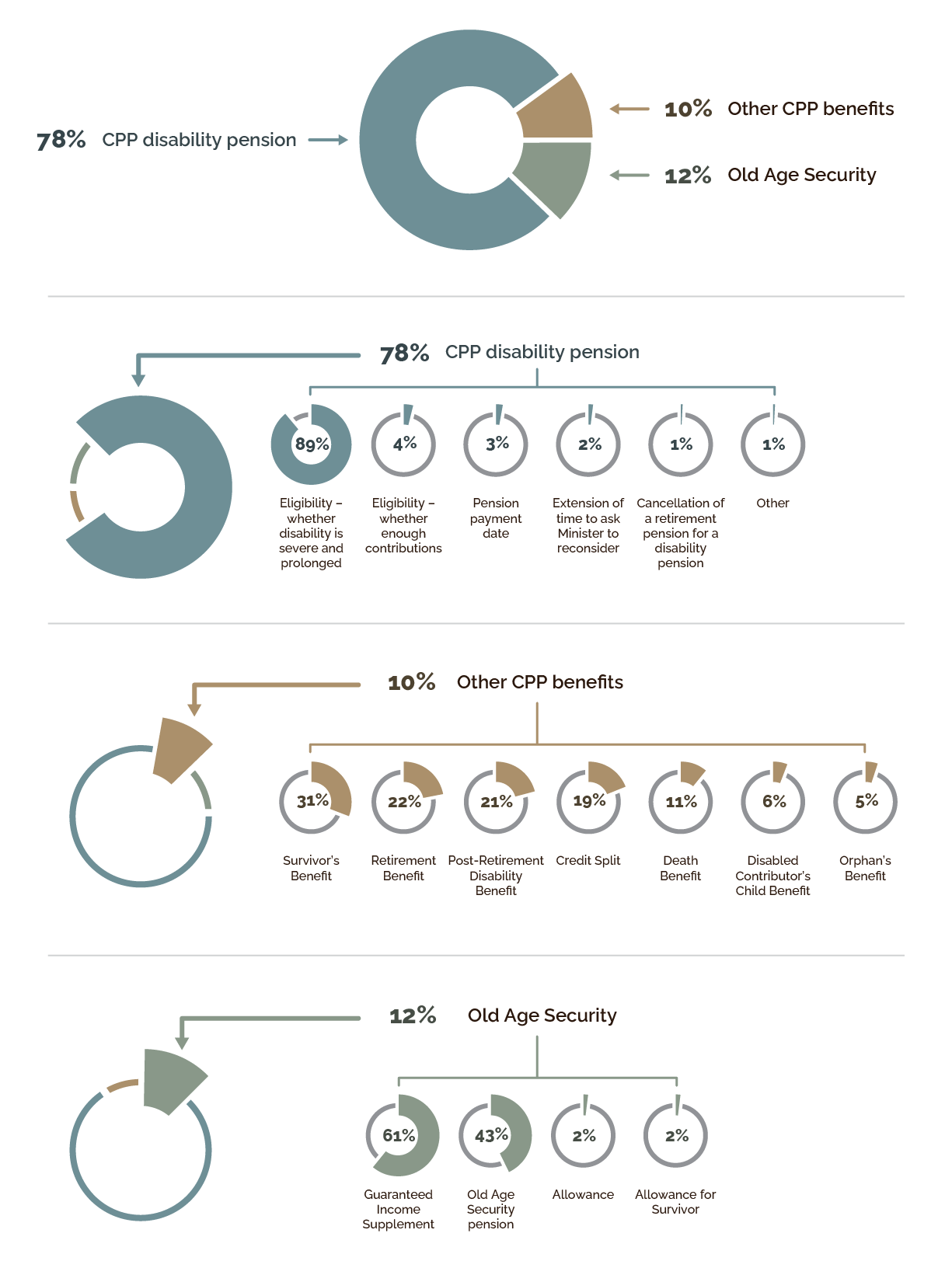
Text version
CPP disability pension - 78% of appeals
Issues raised:
- Eligibility – whether disability is severe and prolonged: 89%
- Eligibility – whether enough contributions: 4%
- Pension payment date: 3%
- Extension of time to ask Minister to reconsider: 2%
- Cancellation of a retirement pension for a disability pension: 1%
- Other: 1%
Other CPP benefits - 10% of appeals
Issues raised:
- Survivor’s Benefit: 31%
- Retirement Benefit: 22%
- Post-Retirement Disability Benefit: 21%
- Credit Split: 19%
- Death Benefit: 11%
- Disabled Contributor’s Child Benefit: 6%
- Orphan’s Benefit: 5%
Old Age Security - 12% of appeals
Issues raised:
- Guaranteed Income Supplement: 61%
- Old Age Security pension: 43%
- Allowance: 2%
- Allowance for Survivor: 2%
Note: some appeals include more than one issue. That’s why the issue percentages for each benefit may add up to more than 100%.
Canada Disability Benefit (CDB) appeals now at the SST
This year, we put in place the appeal process for the new CDB. This fits into the same process as our other Income Security appeals.
If someone disagrees with Service Canada’s reconsideration decision about their eligibility for the benefit or the benefit amount, they can appeal the decision to the SST.
Under the CDB Regulations opens a new window and the Department of Employment and Social Development Act opens a new window:
- CDB appeals come to the SST’s General Division
- parties can appeal the General Division decision to the SST’s Appeal Division, with permission
To reflect this new type of appeal, we made changes to our Rules of Procedure opens a new window. We also made updates to our website, forms, and other materials.
Key initiatives
Developing our new e-filing portal
This year, we created My SST Portal opens a new window: our brand-new platform where appellants can manage their appeal documents online.
With the new portal, you can:
- fill in and submit your appeal forms
- submit supporting documents
- receive documents from us
- keep all your appeal documents organized
- communicate with us through the portal
Representatives can also create an account and use the portal to support the parties they represent.
We designed this tool to be user-friendly. Our goal is to make it easier for people to file an appeal, communicate securely, and find everything they need for their hearing.
Average start-to-finish times
We want the people who use our services to have an idea of how long an appeal might take. That’s why we’ve started sharing the average start-to-finish times for appeals that go to a hearing for these benefits:
- Canada Pension Plan (CPP), including disability
- Old Age Security (OAS) and Guaranteed Income Supplement (GIS)
We measure this from the day the notice of appeal is filed to the day the decision is sent. The length of some steps in this process is outside of our control, so timelines can vary. Individual appeals may be resolved sooner or later than the average.
Average start-to-finish times are different from our service standards. We’ll keep reporting on how we meet our service standards, in addition to sharing this new information.
Making relevant decisions easier to find
This year, we improved our decision search tool even more to help people find cases like theirs. The subject dropdown menu in our advanced search feature opens a new window now gives better results. When a user selects a subject, they’ll get more SST decisions than ever before.
There are many subjects to choose from. This means people can search for a specific topic or issue. When people can find decisions on cases like theirs, it can help them understand how the law works and how members make their decisions. They can also use SST decisions to support their arguments in their appeal.
Policies and practice directions: more transparency on our processes
This year, we continued making our processes clearer for the people we serve. With input from stakeholders, we developed several new policies and practice directions. They explain how we work and what people can expect when they appeal to the SST.
We published our policy on Case file retention and disposition and our practice direction about Using testimony from General Division hearings in Income Security appeals at the Appeal Division, during the fiscal year. We’ll publish additional policy instruments on the use of artificial intelligence (AI) and certain appeal procedures in the future. Learn more about our practice directions and policies.
Learning about the people who come to the SST
This year, we continued using our Gender-based Analysis Plus (GBA Plus) survey to learn more about the people who use our services. The survey includes 20 questions about things like:
- access to technology
- gender
- age
- income
500 people responded this year, bringing the total to 2,171 over more than three years.
This year, we moved ahead on several projects based on what we’ve learned from this data. One area we’re focusing on is understanding how virtual hearings may create barriers and what kinds of accommodations people may need as they move through the appeal process. This work supports access to justice by helping us remove barriers and make our process fair and accessible to everyone who uses it.
Continuing to promote equity, diversity, and inclusion (EDI)
This year, we continued strengthening EDI across the SST by expanding tools and resources that support inclusive decision-making.
We launched the EDI Repository: a central, easy-to-access space for members and staff that brings together information on:
- current EDI and accessibility initiatives
- guidance on inclusive writing
- a range of educational tools and resources
During our annual National Training Seminar for members, we invited the Director of Community Engagement from Indigenous Services Canada to lead a session on the history of the relationship between Indigenous Peoples and the government. The session helped members understand how history shapes the ongoing work of reconciliation and the role that each of us plays in supporting it.
We’ll continue building on this work and integrating EDI principles into our daily operations and workplace culture.
Access to justice indices
This past year, two leaders in the access to justice community, the Department of Justice Canada and the Society of Ontario Adjudicators and Regulators, released self-assessment tools designed to help tribunals improve access to justice. We reviewed our practices against both tools.
The results show that the SST is already meeting almost all the recommended practices. We’re performing strongly in key areas like:
- accommodation and accessibility
- choice of hearing format
- supports available to parties
- how we use data
We’ll continue using tools like these to find and remove barriers and to strengthen access to justice for all participants.
Decision highlights
Income Security appeals
When someone appeals a CPP disability decision to the Appeal Division, the Minister sometimes brings a doctor who works for Employment and Social Development Canada (ESDC) to testify at the hearing.
CPP disability pension – non-treating professional witness
In SB v Minister of Employment and Social Development, 2025 SST 827 opens a new window, the Claimant said the Minister’s professional witness, who didn’t treat the Claimant, should not be allowed to testify. The Appeal Division allowed the witness to testify noting that (1) the Tribunal isn’t a court and doesn’t strictly follow the rules of evidence like in civil and criminal courts; (2) the proposed evidence appeared to be useful; (3) the Social Security Tribunal Rules of Procedure allow the Minister to present this type of evidence; and (4) allowing the Minister to have its witness testify is consistent with fairness.
A person who turns 65 may be automatically enrolled for the OAS pension. If the Minister intends to auto-enroll someone, it has to send them a written notice that includes key information. Some people prefer to delay their pension because the rate goes up between age 65 and 70.
OAS – auto-enrollment and notice requirements
In Minister of Employment and Social Development v JP, 2025 SST 1377 opens a new window, a three-member panel of the Appeal Division made findings about the auto-enrollment notice requirements:
- The notice is about the Minister’s intent to enroll, so it has to be sent before they actually enroll the person.
- The notice has to include that the person (1) has a current address in Canada; (2) is about to turn 65; and (3) has resided in Canada for 40 years or more after age 18. Any notice that leaves out even one of these elements is invalid.
- The Minister has to show that a valid notice was sent to the person, but it doesn’t have to prove that the person received the notice.
In this case, the Minister didn’t prove that it sent a valid notice, so the auto-enrollment didn’t take effect.
The Old Age Security Regulations say that time spent working abroad for a Canadian company doesn’t interrupt a person’s residence in Canada, for the purpose of qualifying for OAS benefits. To benefit from the “Canadian Company Rule,” a person must have “had in Canada a permanent place of abode to which [they] intended to return, or maintained in Canada a self-contained domestic establishment.”
OAS – the Canadian Company Rule
The Appeal Division interpreted these terms in AP v Minister of Employment and Social Development, 2024 SST 333 opens a new window and AC v Minister of Employment and Social Development and GC, 2024 SST 1453 opens a new window. A permanent place of abode is a single, fixed place that the person considers their home, where they have been physically present, and where they intend to return to on an ongoing basis. Maintaining a self-contained domestic establishment means actively caring for a specific residence.
In both cases, the Appellants didn’t meet these requirements and could not benefit from the Canadian Company Rule. On judicial review, the Federal Court of Appeal found the Appeal Division’s decisions to be reasonable: Paulus v Canada (Attorney General), 2025 FCA 162 opens a new window and Cardenas v Canada (Attorney General), 2026 FCA 11 opens a new window.
Employment Insurance appeals
In response to the COVID-19 pandemic, a temporary measure in the Employment Insurance Act created a one-time credit of insurable hours to facilitate access to benefits.
Charter challenge – one-time credit of insurable hours
In Canada Employment Insurance Commission v RL, 2026 SST 76 opens a new window, the Claimant could not use the credit when she needed it because it had been applied to her previous claim. A three-member panel of the Appeal Division considered whether the one-time credit discriminated against women by automatically being applied to a first claim for benefits. The Claimant argued that women were more likely than men to need both regular and special benefits during the pandemic. So, they were more likely to need the hours credit for a second claim for benefits.
The Appeal Division concluded that the General Division had made errors in its analysis under section 15 of the Canadian Charter of Rights and Freedoms. It found that the one-time credit wasn’t unconstitutional as the measures were designed to ensure—and did ensure—that claimants could access regular benefits, special benefits, or both. The one-time credit didn’t change the pre-existing EI rules, which limit claimants to the maximum weeks of combined benefits unless they have enough hours to establish a new claim. The Appeal Division also found that the one-time credit was intended to ease the transition from the EI Emergency Response Benefit, and the evidence showed that women relied more heavily on the credit at that time.
The Claimant has asked the Federal Court of Appeal to review this decision.
Someone who is self-employed has the option of signing up for an EI program that allows them to get maternity, parental, sickness, and caregiver benefits. The amount of their self-employed earnings determines whether they qualify for benefits, how much they have to pay, and what benefit rate they’ll receive.
Self-employed annual earnings
In several decisions, the Appeal Division has found that section 97 of the Employment Insurance Act gives the CRA exclusive authority to determine a person’s self employed annual earnings. It is an error of jurisdiction for the General Division to make its own decision about the amount of self-employed earnings. See, for example, Canada Employment Insurance Commission v CC,2025 SST 1056 opens a new window and Canada Employment Insurance Commission v AT, 2024 SST 1559 opens a new window.
Procedural fairness
SST members have to make sure that the appeal process is procedurally fair. This includes using active adjudication to make sure parties can participate fully.
Active adjudication and procedural fairness
In TW v Canada Employment Insurance Commission and X, 2025 SST 1025 opens a new window, the Appeal Division found that fairness was compromised when the General Division hearing went ahead without an interpreter for the Claimant. Although the Claimant’s representative had agreed to continue, he didn’t understand that it was a new hearing or that testimony would be required. This was information the General Division should have explained.
Fairness issues also came up in CB v Canada Employment Insurance Commission, 2025 SST 1127 opens a new window. The Appeal Division found the General Division didn’t adequately respond to the Claimant’s question about submitting a sensitive medical report. The General Division should have explained to the Claimant the implications for her evidence and found out whether the Claimant wanted time to submit the document.
In another case, the General Division moved ahead with a hearing despite clear indications that the Claimant was trying to add her representative to the file and needed time for her representative to receive the documents. The Appeal Division found that going ahead under those circumstances was procedurally unfair: TR v Canada Employment Insurance Commission, 2025 SST 880 opens a new window.
In PM v Canada Employment Insurance Commission, 2025 SST 1122 opens a new window, the Appeal Division held that the Claimant was denied procedural fairness. The General Division issued its decision without first giving him an opportunity to respond to a CRA ruling about his insurable hours. The Claimant should have been asked if he had any submissions to make or if he intended to appeal the CRA ruling.
The SST decides these and many other issues under the Canada Pension Plan, Old Age Security Act, Canada Disability Benefit Act, and Employment Insurance Act. You can browse published decisions opens a new window in our decision database or search by:
- case number
- subject
- date
- appeal level
- result
Our database now has 17,644 decisions.
Our Income Security numbers
General Division
Inventory
Text version
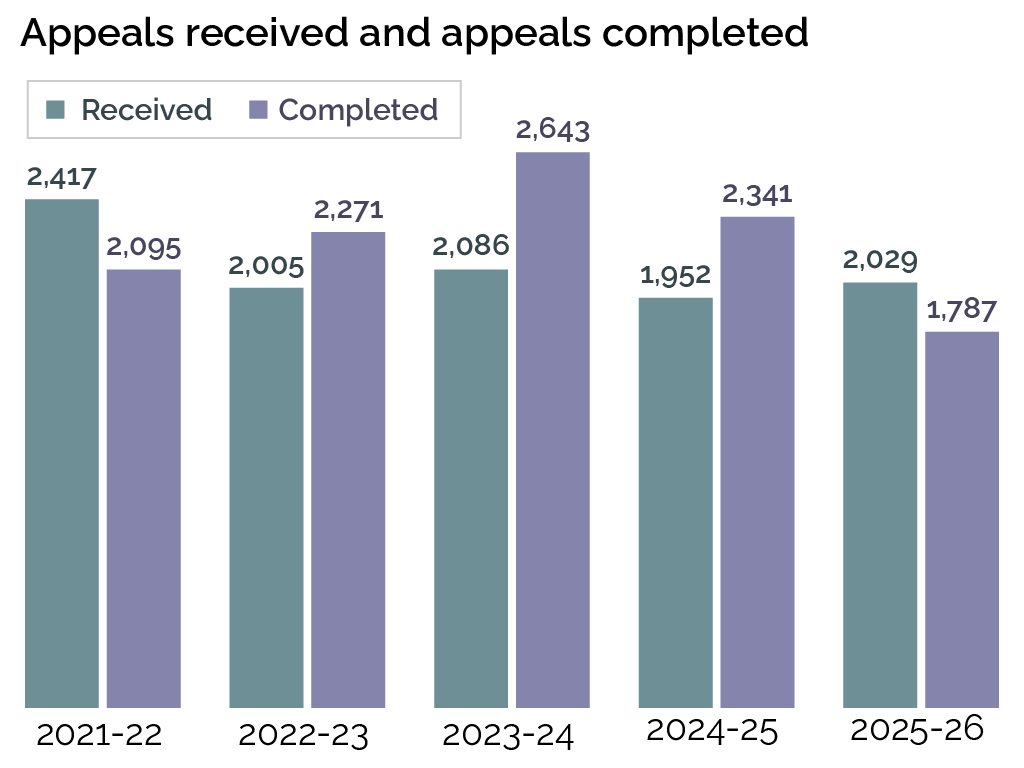
Appeals received and appeals completed. In 2021 to 2022, we received 2,417 appeals and completed 2,095 appeals. In 2022 to 2023, we received 2,005 appeals and completed 2,271 appeals. In 2023 to 2024, we received 2,086 appeals and completed 2,643 appeals. In 2024 to 2025, we received 1,952 appeals and completed 2,341 appeals. In 2025 to 2026, we received 2,029 appeals and completed 1,787 appeals.
Text version
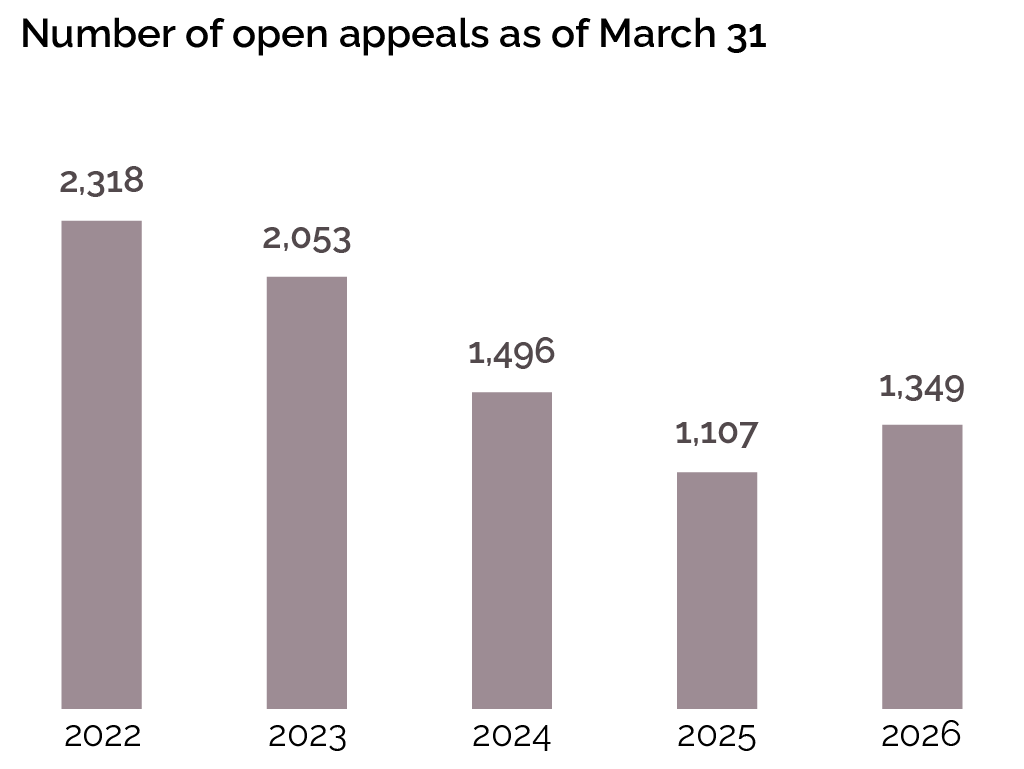
Number of open appeals as of March 31. On March 31, 2022, there were 2,318 open appeals. On March 31, 2023, there were 2,053. On March 31, 2024, there were 1,496. On March 31, 2025, there were 1,107. On March 31, 2026, there were 1,349.
Processing times
Text version
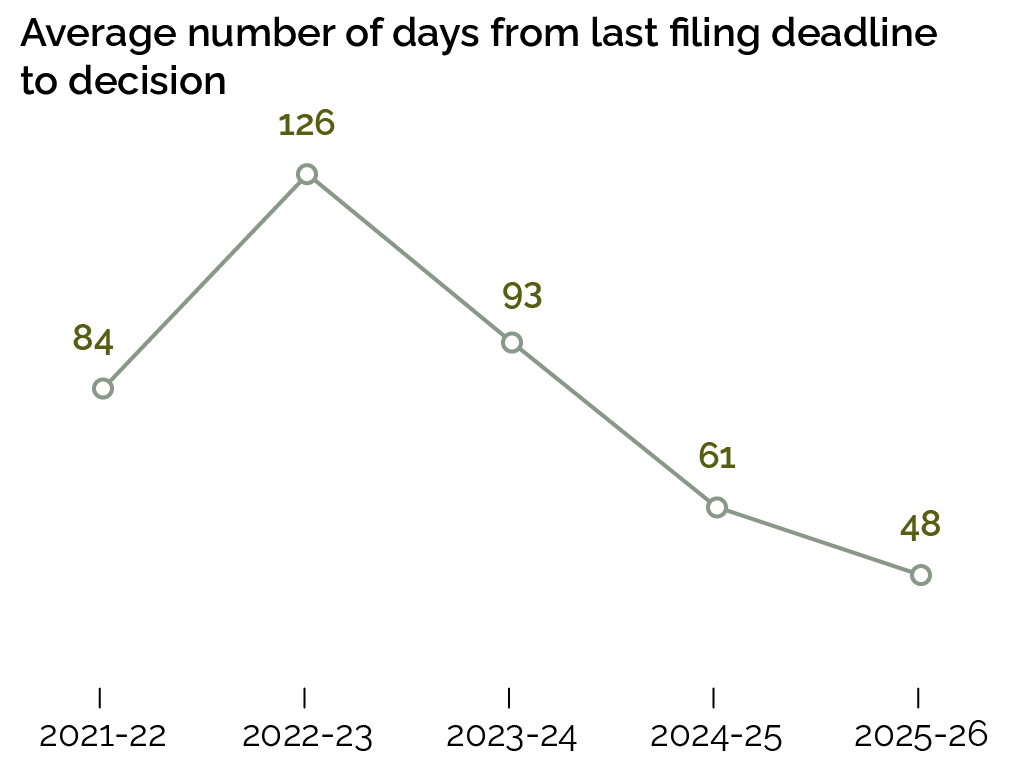
Average number of days from last filing deadline to when we gave a decision. In 2021 to 2022, our average was 84 days. In 2022 to 2023, it was 126 days. In 2023 to 2024, it was 93 days. In 2024 to 2025, it was 61 days. In 2025 to 2026, it was 48 days.
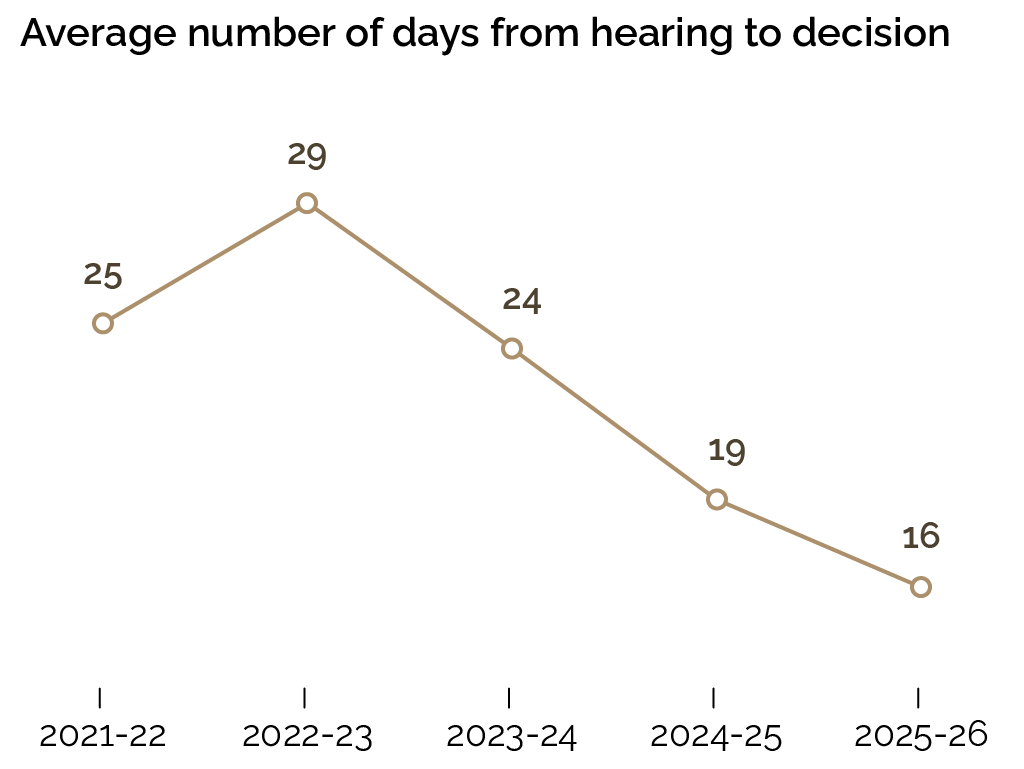
Text version
Average number of days from the hearing to when we gave a decision. In 2021 to 2022, our average was 25 days. In 2022 to 2023, it was 29 days. In 2023 to 2024, it was 24 days. In 2024 to 2025, it was 19 In 2025 to 2026, it was 16 days.
Average start-to-finish times for Income Security appeals
- Canada Pension Plan disability – 271 days
- Other Canada Pension Plan – 164 days
- Old Age Security and Guaranteed Income Supplement – 301 days
Service standards
Under our service standards, we aim to give the decision within 90 days of the last filing deadline, at least 80% of the time. We also aim to give the decision within 30 days of the hearing, at least 80% of the time.
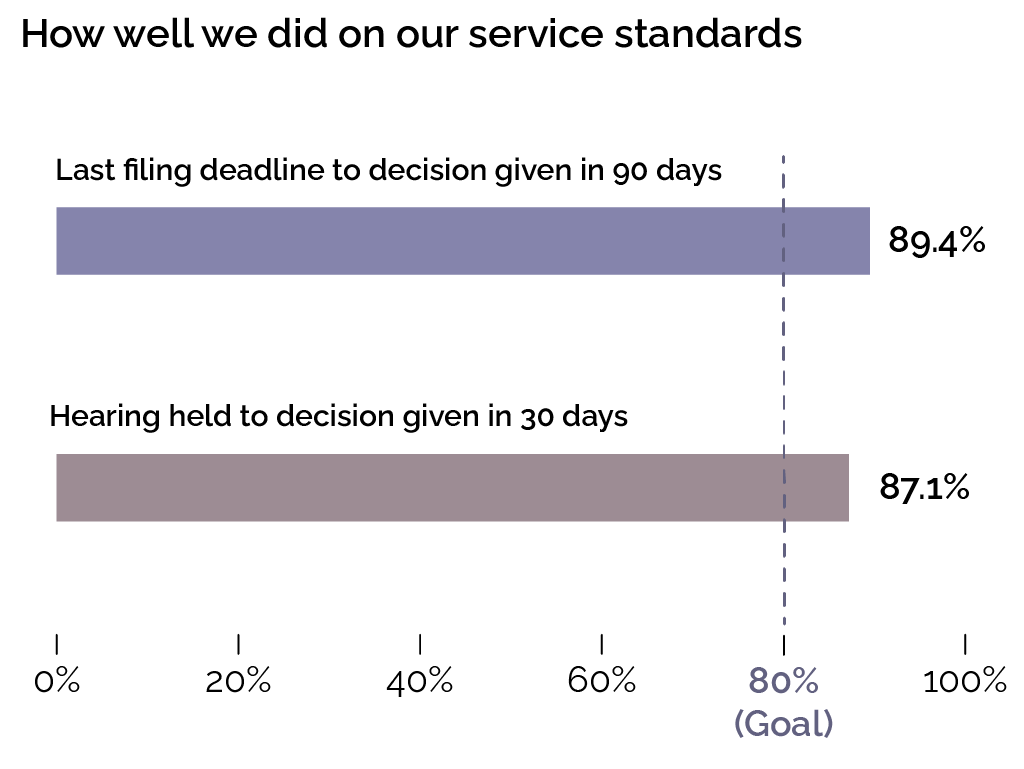
Text version
How well we did on our service standards. We gave the decision within 90 days of the last filing deadline 89.4% of the time. We gave the decision within 30 days of the hearing 87.1% of the time.
Appeal Division
Inventory
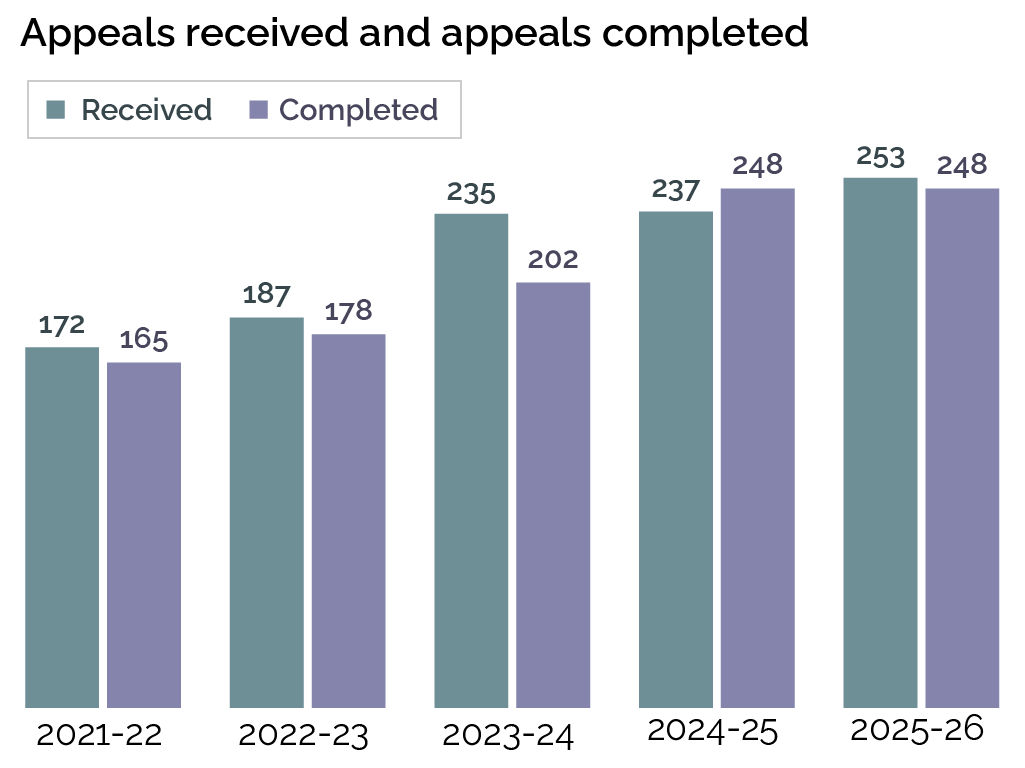
Text version
Appeals received and appeals completed. In 2021 to 2022, we received 172 appeals and completed 165. In 2022 to 2023, we received 187 appeals and completed 178. In 2023 to 2024, we received 235 appeals and completed 202. In 2024 to 2025, we received 237 appeals and completed 248. In 2025 to 2026, we received 253 appeals and completed 248.
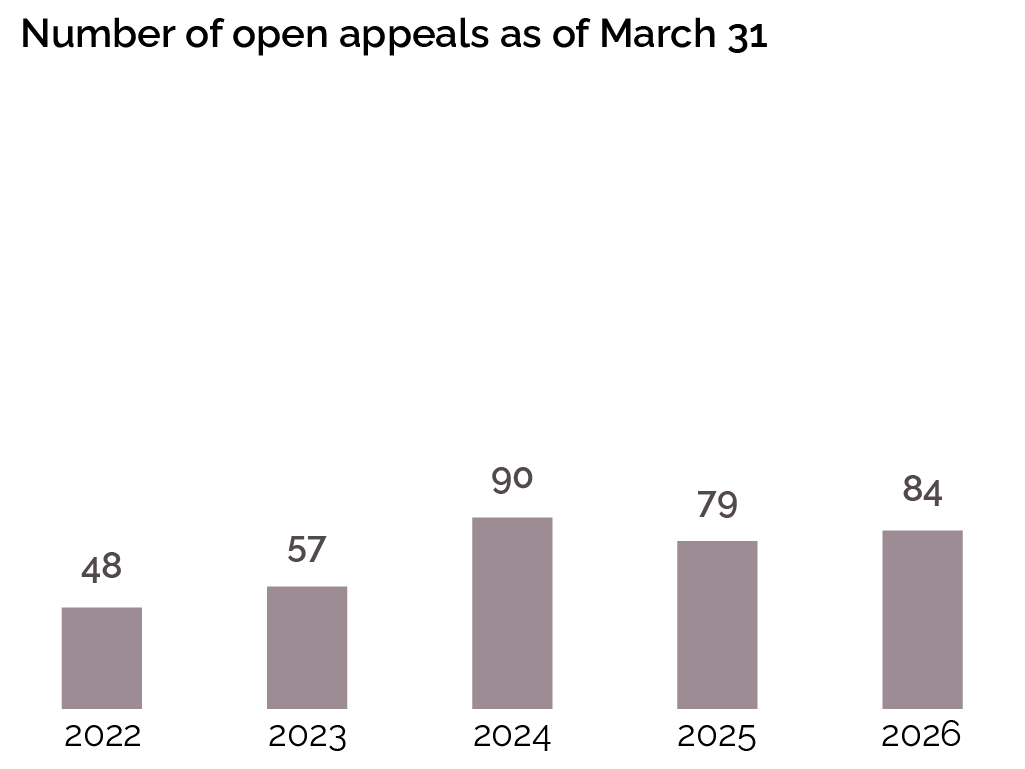
Text version
Number of open appeals as of March 31. On March 31, 2022, there were 48 open appeals. On March 31, 2023, there were 57. On March 31, 2024, there were 90. On March 31, 2025, there were 79. On March 31, 2026, there were 84.
Processing times
Text version
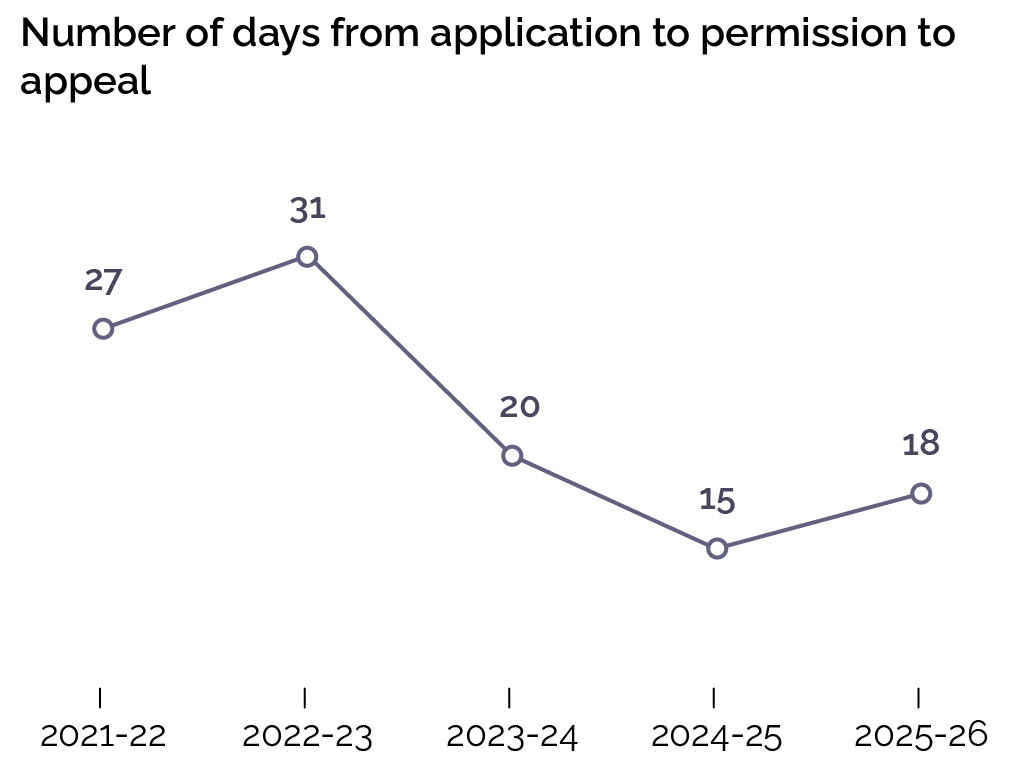
Number of days from application to permission to appeal. In 2021 to 2022, the average time was 27 days. In 2022 to 2023, it was 31 days. In 2023 to 2024, it was 20 days. In 2024 to 2025, it was 15 days. In 2025 to 2026, it was 18 days.
Text version
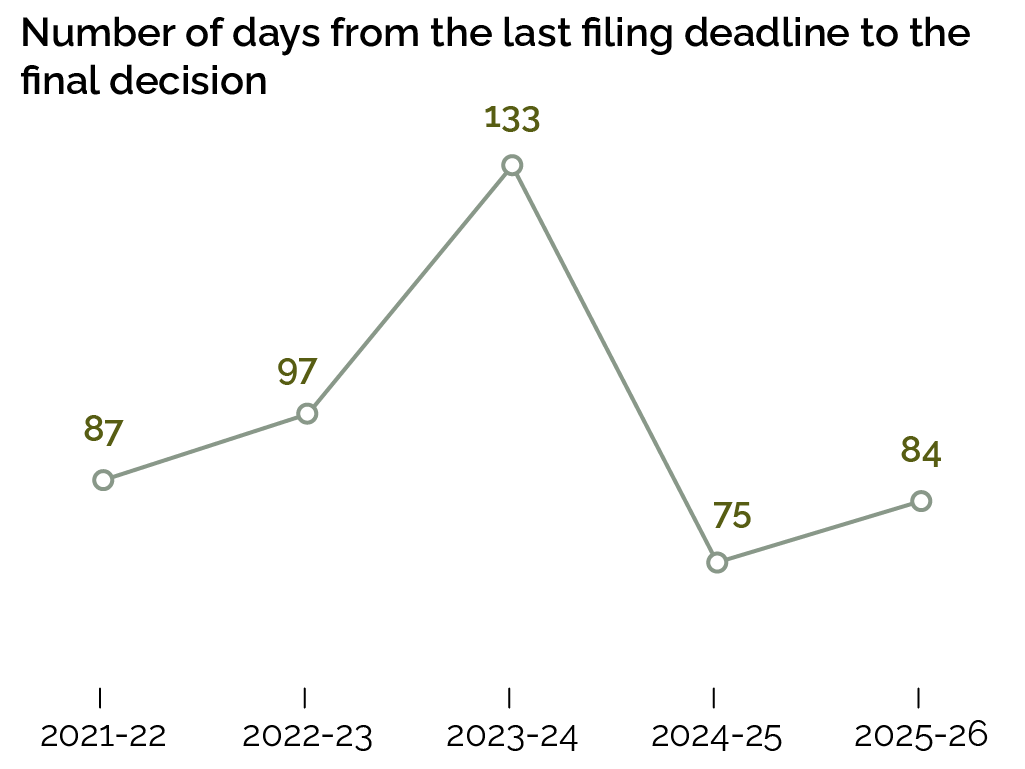
Number of days from the last filing deadline to the final decision. In 2021 to 2022, the average time was 87 days. In 2022 to 2023, it was 97 days. In 2023 to 2024, it was 133 days. In 2024 to 2025, it was 75 days. In 2025 to 2026, it was 84 days.
Text version
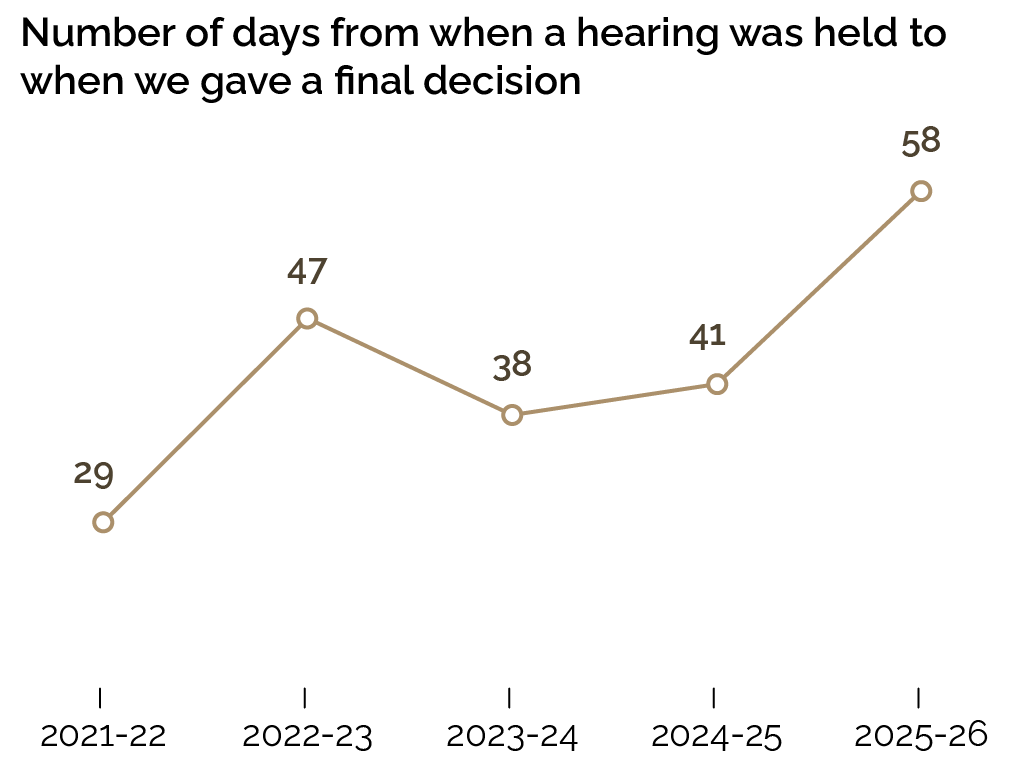
Number of days from when a hearing was held to when we gave a final decision. In 2021 to 2022, the average was 29 days. In 2022 to 2023, it was 47 days. In 2023 to 2024, it was 38 days. In 2024 to 2025, it was 41 days. In 2025 to 2026, it was 58 days.
Average start-to-finish times for Income Security appeals
- Canada Pension Plan disability – 229 days
- Other Canada Pension Plan – 206 days
- Old Age Security – 263 days
Service standards
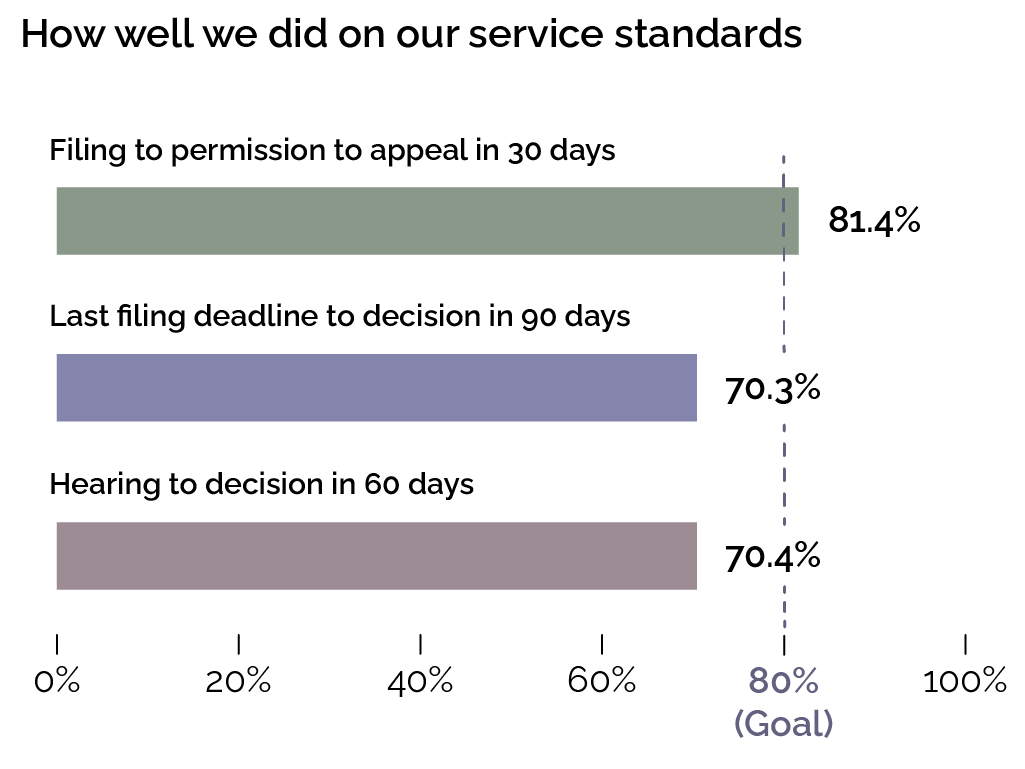
Under our service standards, we aim to meet the following timelines 80% of the time:
- Decide on permission to appeal within 30 days
- Give the final decision within 90 days of the last filing deadline
- Give the final decision within 60 days from the hearing
Text version
How well we did on our service standards. We decided on permission to appeal within 30 days from filing 81.4% of the time. We gave the decision within 90 days of the last filing deadline 70.3% of the time. We gave the decision within 60 days of the hearing 70.4% of the time.
Appeal origin
Text version
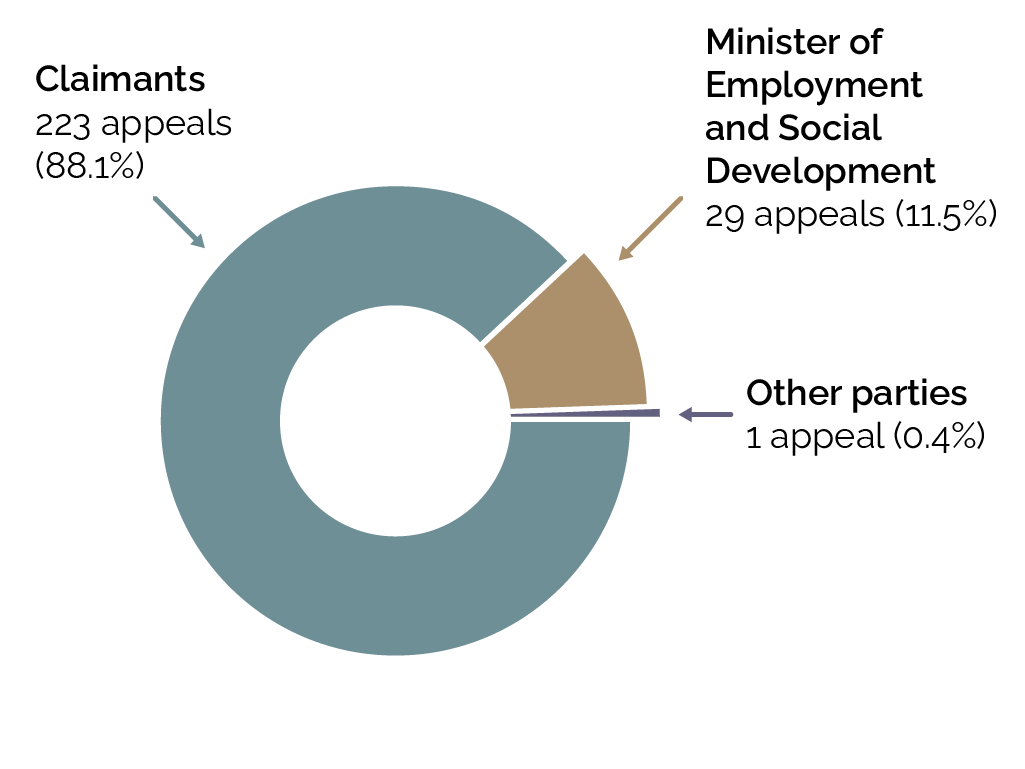
Appeal origin. 88.1% of appeals (223 appeals) were started by claimants; 11.5% (29 appeals) were started by the Minister of Employment and Social Development; 0.4% (1 appeal) were started by other parties.
Alternative dispute resolution (ADR)
The Appeal Division brings parties together for ADR when they may be able to resolve the appeal without a hearing. For the 2025 to 2026 fiscal year, 16.5% (41) of resolved Appeal Division Income Security cases went through the ADR process. Of these cases, 97.6% were resolved.
Our Employment Insurance numbers
General Division
(Numbers exclude group appeals)
Inventory
Text version
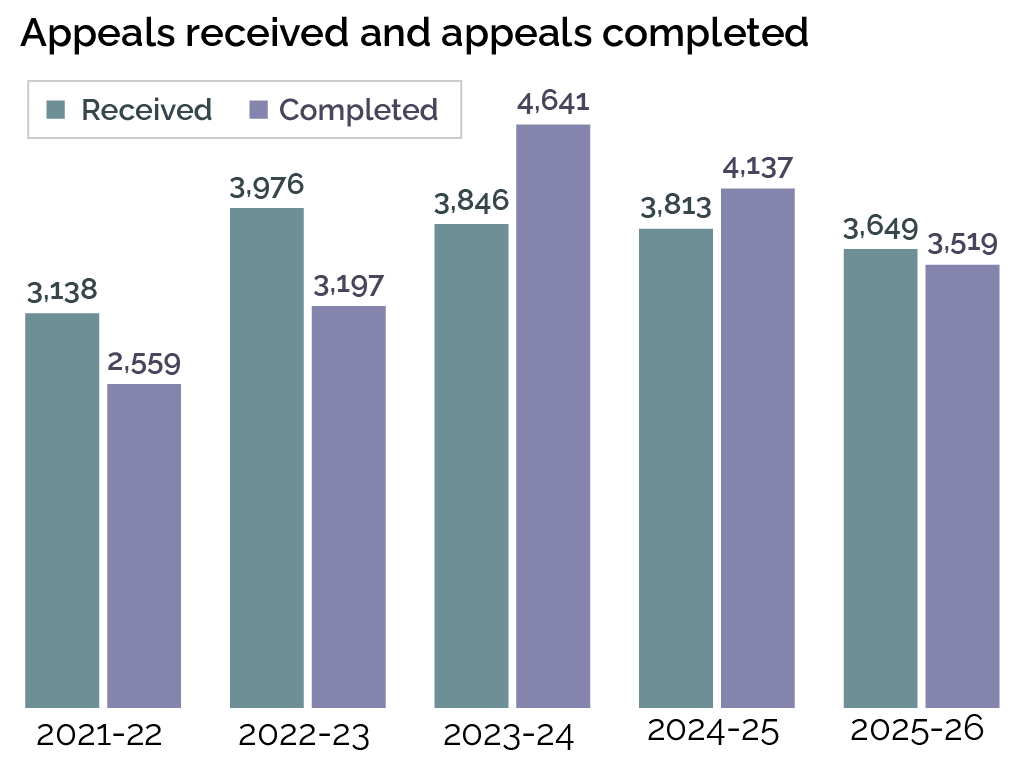
Appeals received and appeals completed. In 2021 to 2022, we received 3,138 appeals and completed 2,559 appeals. In 2022 to 2023, we received 3,976 appeals and completed 3,197. In 2023 to 2024, we received 3,846 appeals and completed 4,641. In 2024 to 2025, we received 3,813 appeals and completed 4,137. In 2025 to 2026, we received 3,649 appeals and completed 3,519.
Text version
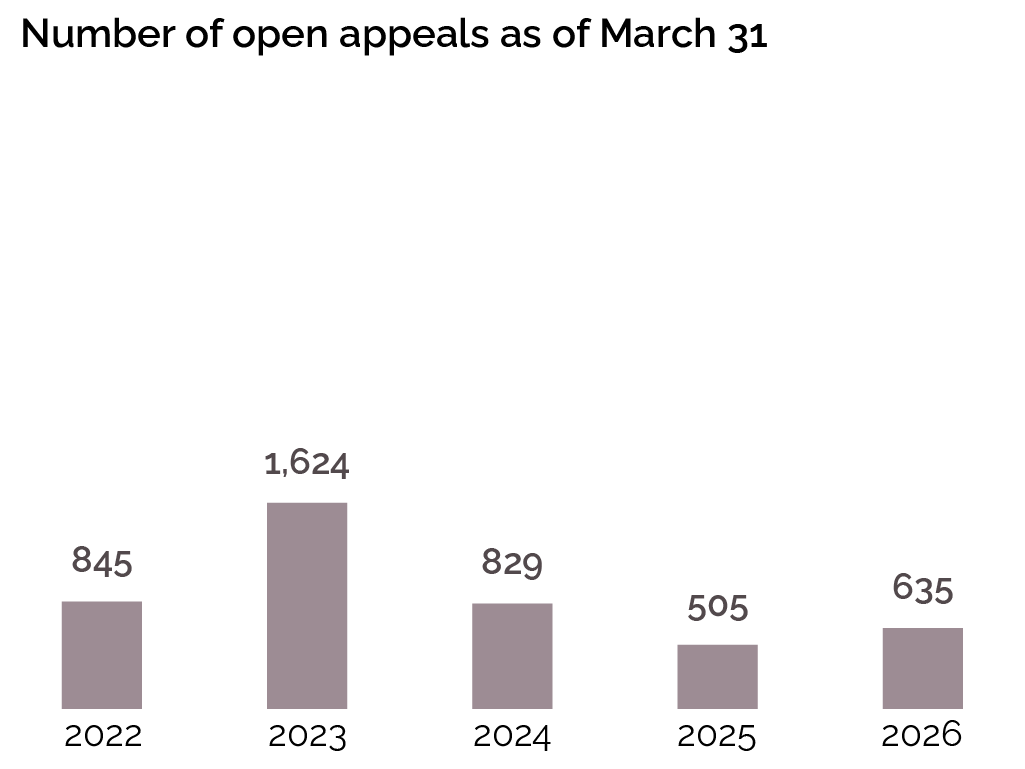
Number of open appeals as of March 31. On March 31, 2022, there were 845 open appeals. On March 31, 2023, there were 1,624. On March 31, 2024, there were 829. On March 31, 2025, there were 505. On March 31, 2026, there were 635.
Processing times
Text version
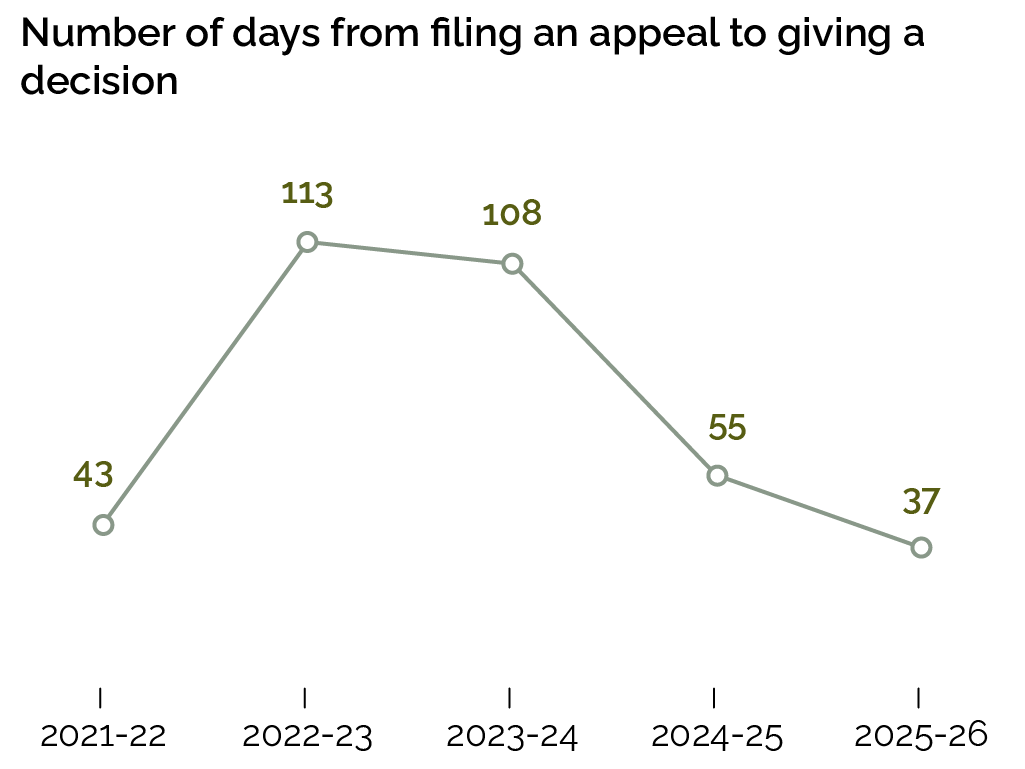
Number of days from filing an appeal to giving a decision. In 2021 to 2022, the average time was 43 days. In 2022 to 2023, it was 113 days. In 2023 to 2024, it was 108 days. In 2024 to 2025, it was 55 days. In 2025 to 2026, it was 37 days.
Text version
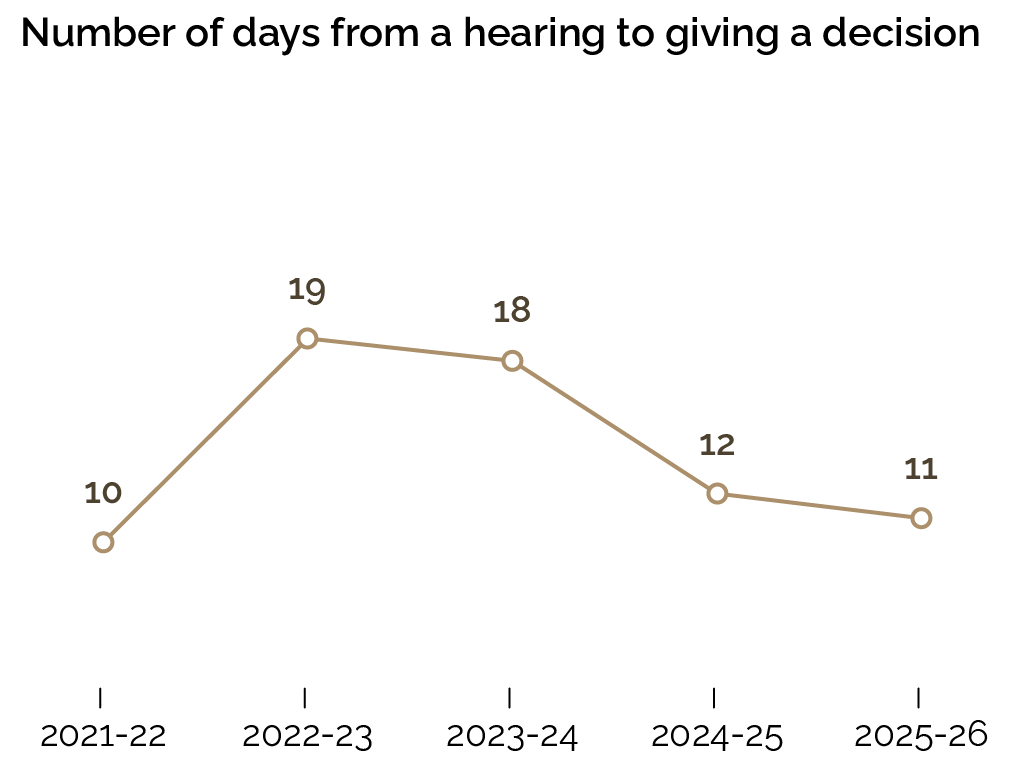
Number of days from a hearing to giving a decision. In 2021 to 2022, the average time was 10 days. In 2022 to 2023, it was 19 days. In 2023 to 2024, it was 18 days. In 2024 to 2025, it was 12 days. In 2025 to 2026, it was 11 days.
Service standards
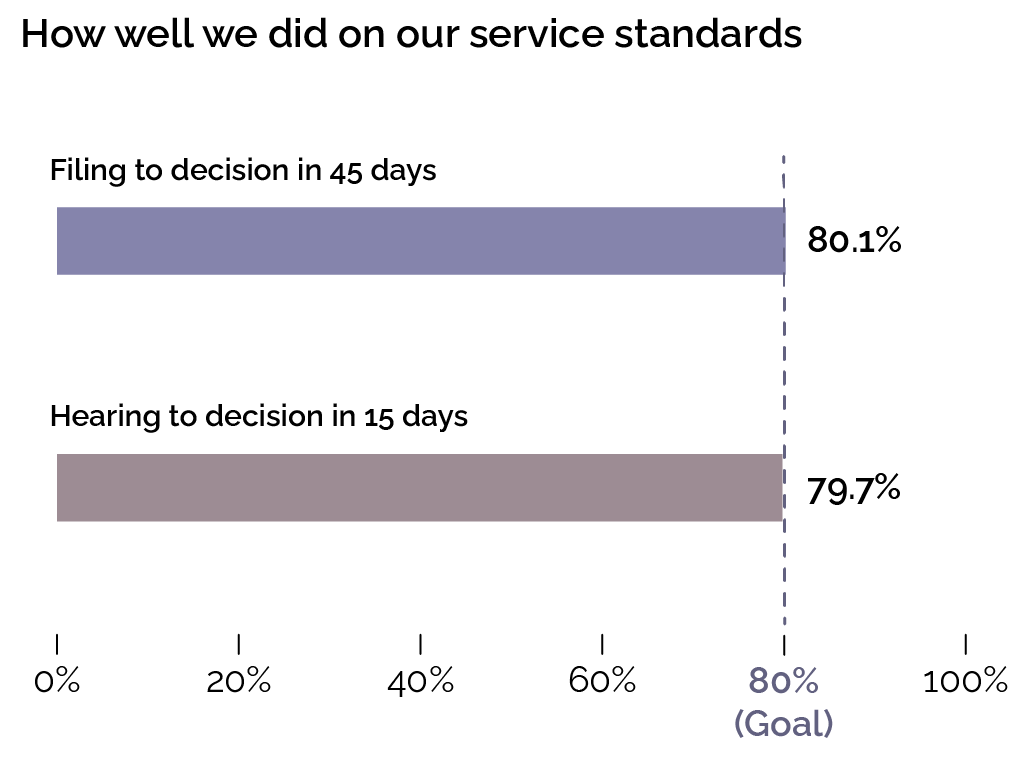
We aim to give appellants their decision within 45 days from when they file their appeal, and within 15 days of their hearing, at least 80% of the time.
Text version
How well we did on our service standards. We gave the decision within 45 days 80.1% of the time. We gave the decision within 15 days of the hearing 79.7% of the time.
Appeal origin
Text version
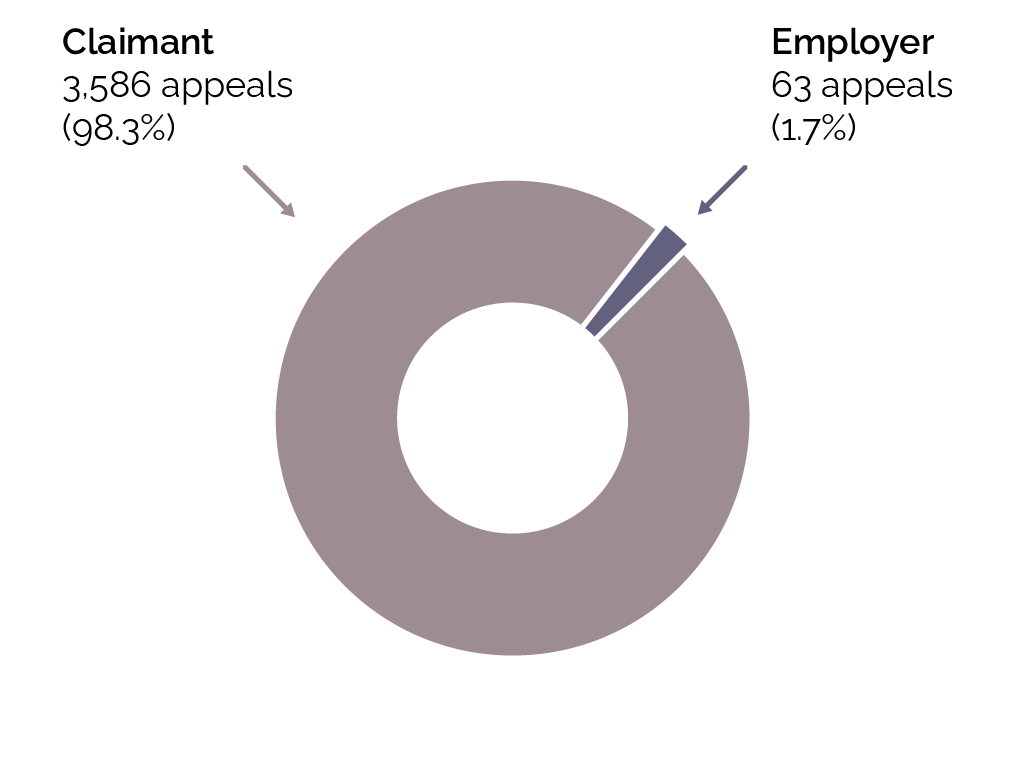
Appeal origin. 98.3% of appeals (3,586 appeals) were from claimants; 1.7% (63 appeals) were from employers.
Appeal Division
(Numbers exclude group appeals)
Inventory
Text version
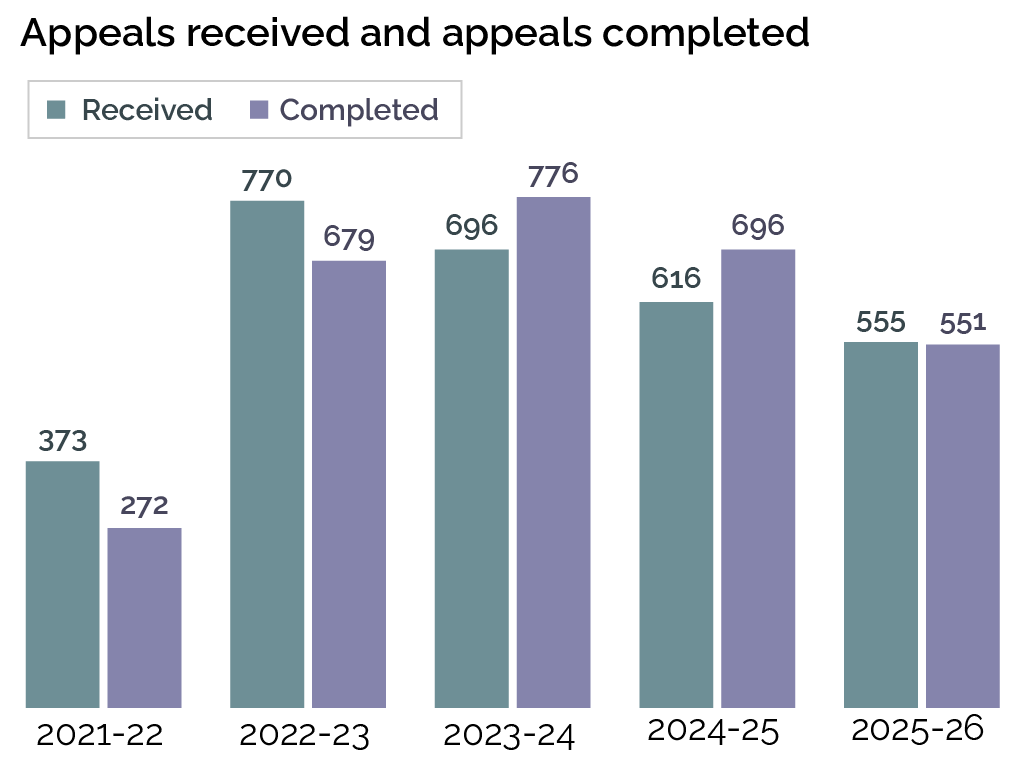
Appeals received and completed. In 2021 to 2022, we received 373 appeals and completed 272 appeals. In 2022 to 2023, we received 770 appeals and completed 679. In 2023 to 2024, we received 696 appeals and completed 776. In 2024 to 2025, we received 616 appeals and completed 696. In 2025 to 2026, we received 555 appeals and completed 551.
Text version
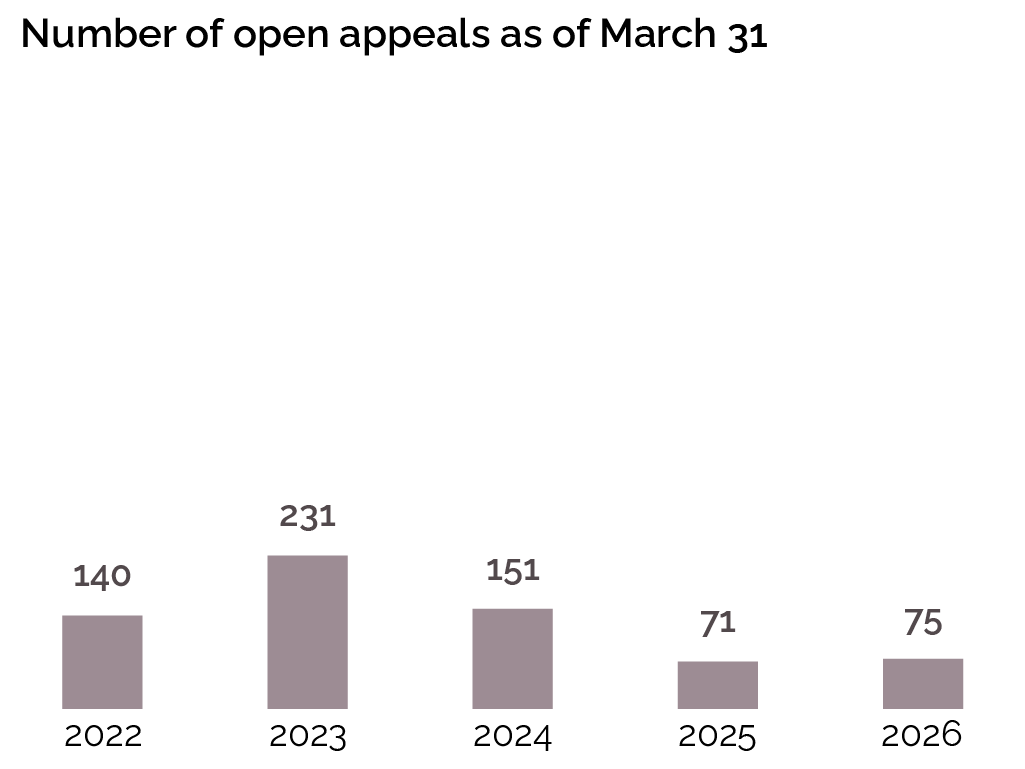
Number of open appeals as of March 31. On March 31, 2022, there were 140 open appeals. On March 31, 2023, there were 231. On March 21, 2024, there were 151. On March 31, 2025, there were 71. On March 31, 2026, there were 75.
Processing times
Text version
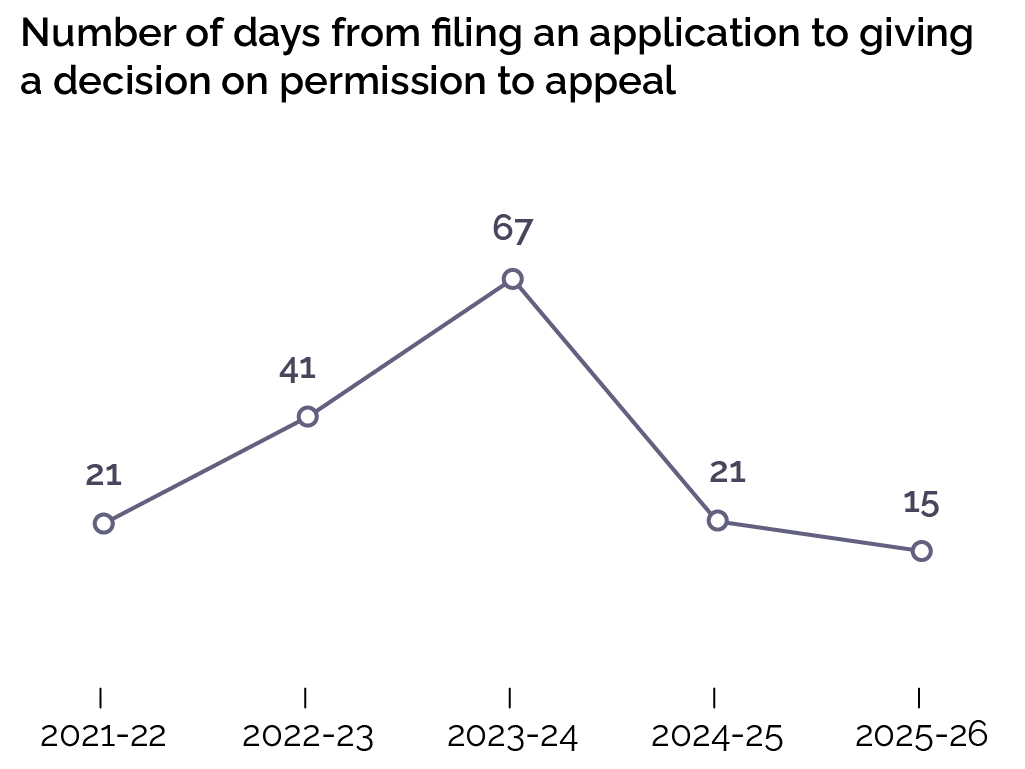
Number of days from filing an application to giving a decision on permission to appeal. In 2021 to 2022, the average time was 21 days. In 2022 to 2023, it was 41 days. In 2023 to 2024, it was 67 days. In 2024 to 2025, it was 21 days. In 2025 to 2026, it was 15 days.
Text version
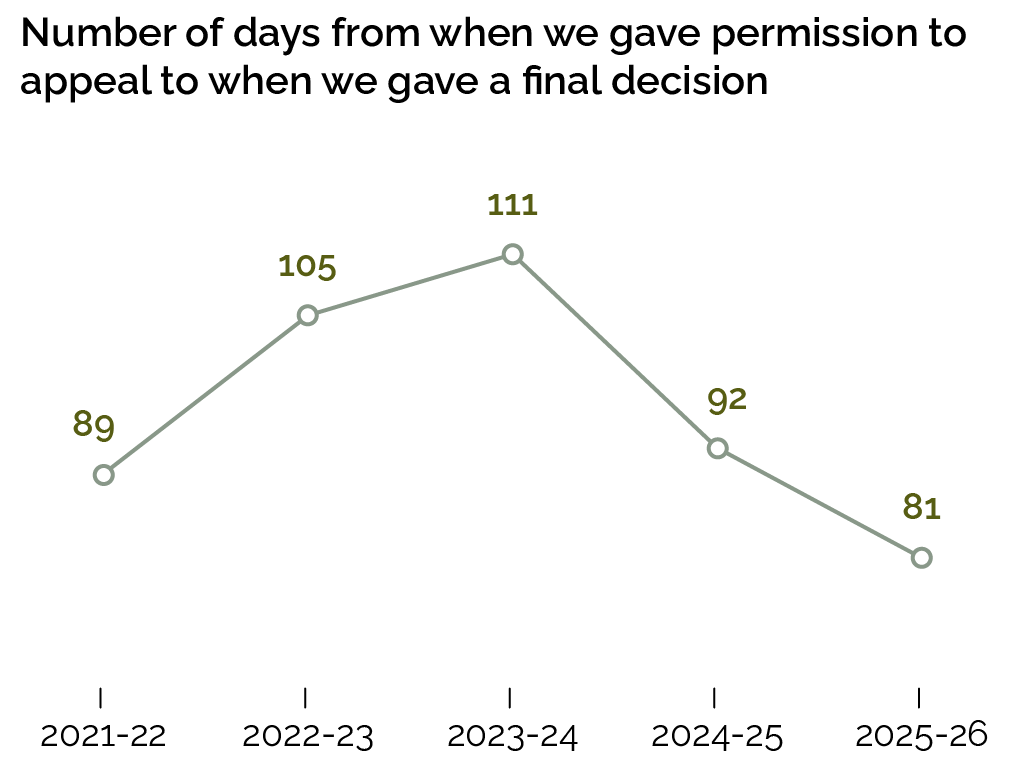
Number of days from when we gave permission to appeal to when we gave a final decision. In 2021 to 2022, the average was 89 days. In 2022 to 2023, it was 105 days. In 2023 to 2024, it was 111 days. In 2024 to 2025, it was 92 days. In 2025 to 2026, it was 81 days.
Text version
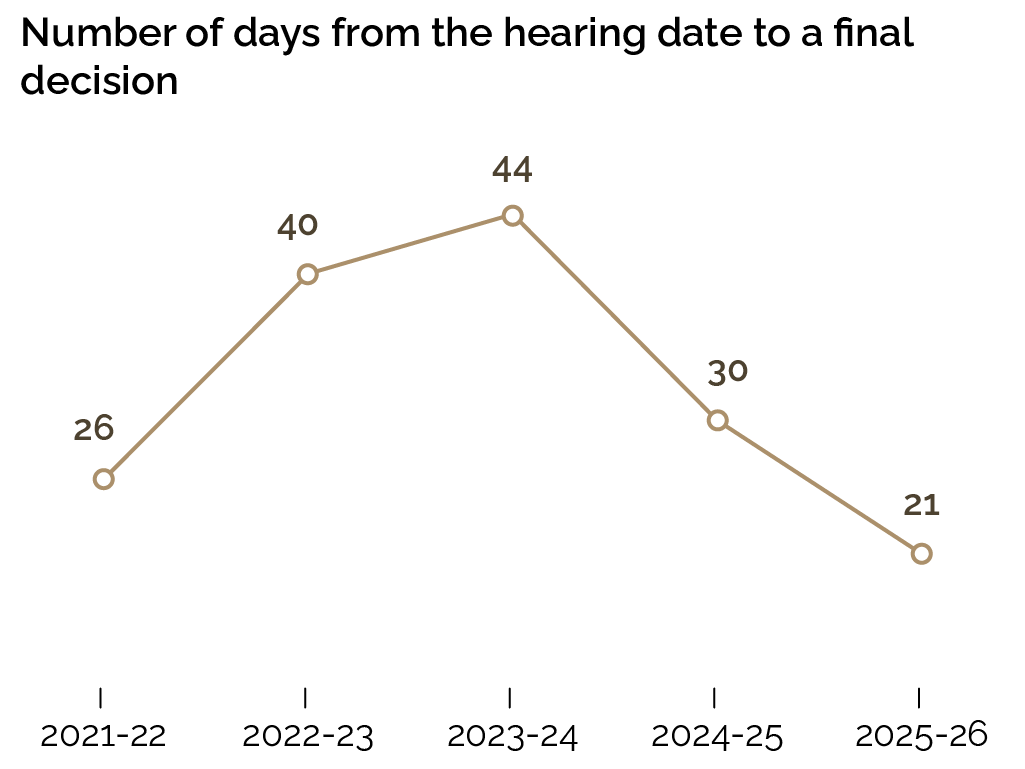
Number of days from the hearing date to a final decision. In 2021 to 2022, the average time was 26 days. In 2022 to 2023, it was 40 days. In 2023 to 2024, it was 44 days. In 2024 to 2025, it was 30 days. In 2025 to 2026, it was 21 days.
Service standards
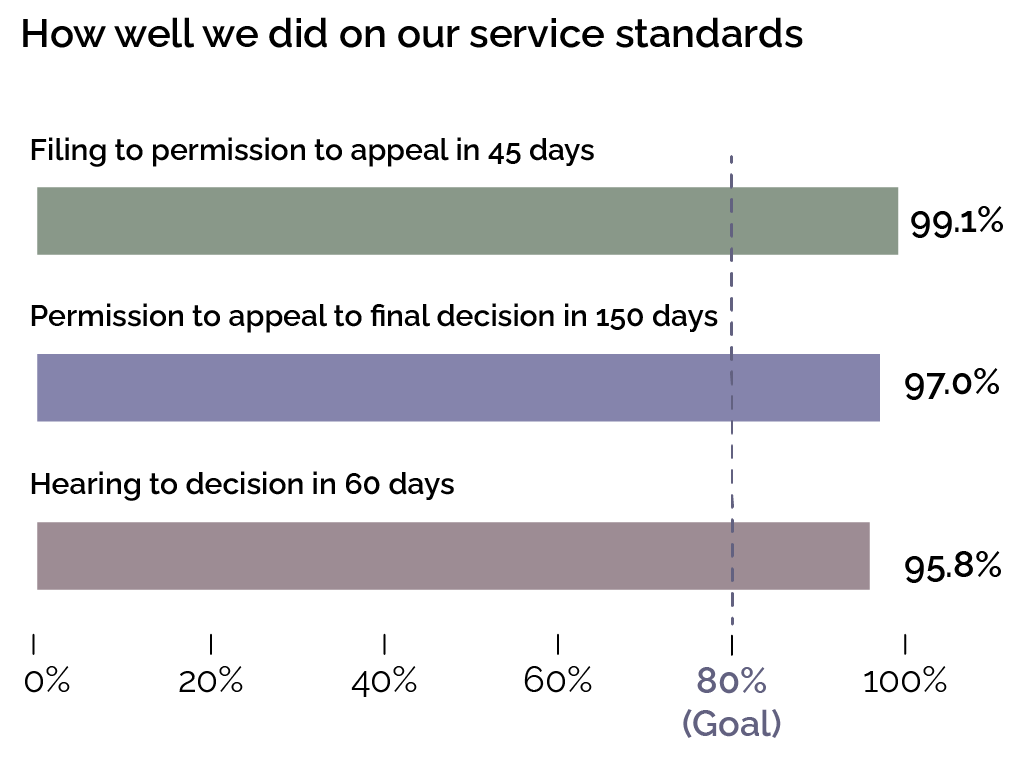
We aim to give appellants a decision about permission to appeal within 45 days of filing an appeal, at least 80% of the time. We aim to make the final decision within 150 days of getting permission to appeal, and within 60 days of the hearing, at least 80% of the time.
Text version
How well we did on our service standards. We decided on permission to appeal within 45 days 99.1% of the time. We gave the decision within 150 days of permission to appeal 97% of the time. We gave the decision within 60 days of the hearing 95.8% of the time.
Appeal origin
Text version
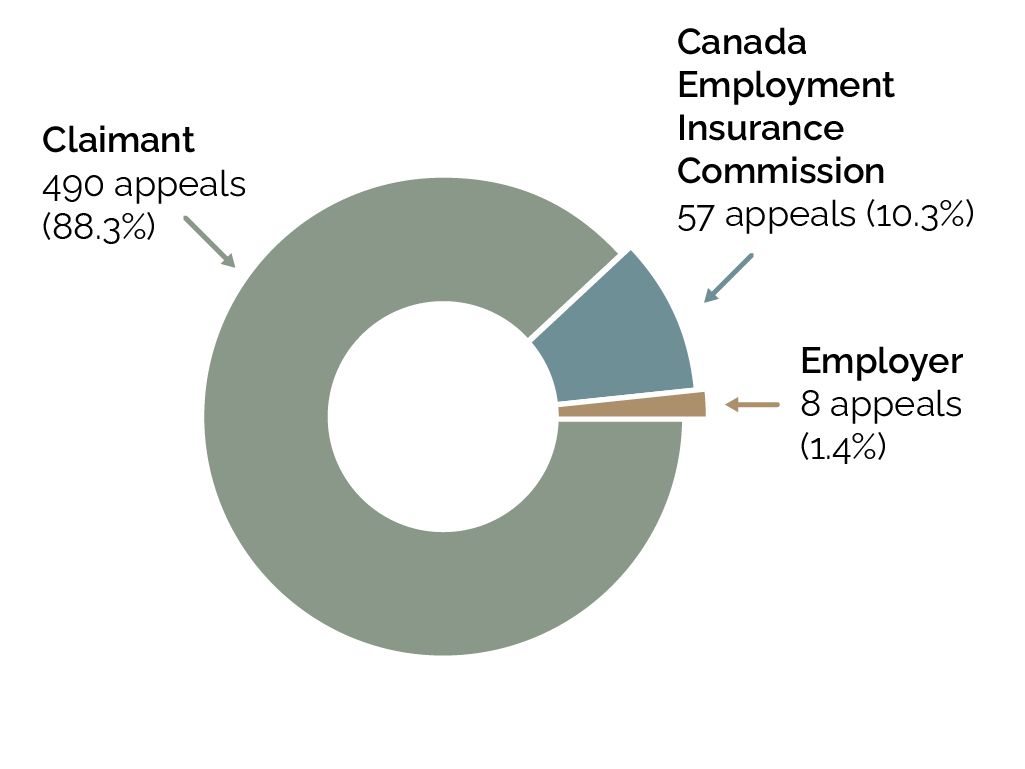
88.3% of appeals (490 appeals) were from claimants; 10.3% (57 appeals) were from the Canada Employment Insurance Commission; 1.4% (8 appeals) were from employers.
Alternative dispute resolution (ADR)
The Appeal Division brings parties together for ADR when they may be able to resolve the appeal without a hearing. This year, 3.8% (21) of EI cases went through ADR, and 57.1% of them were resolved.
Group appeals
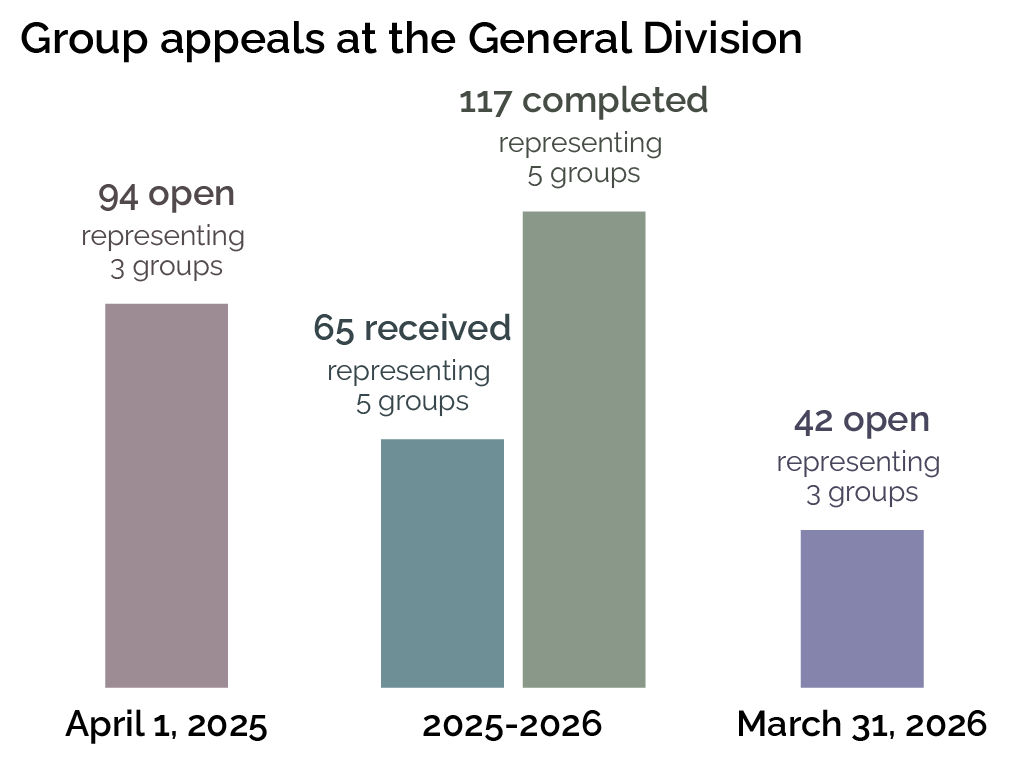
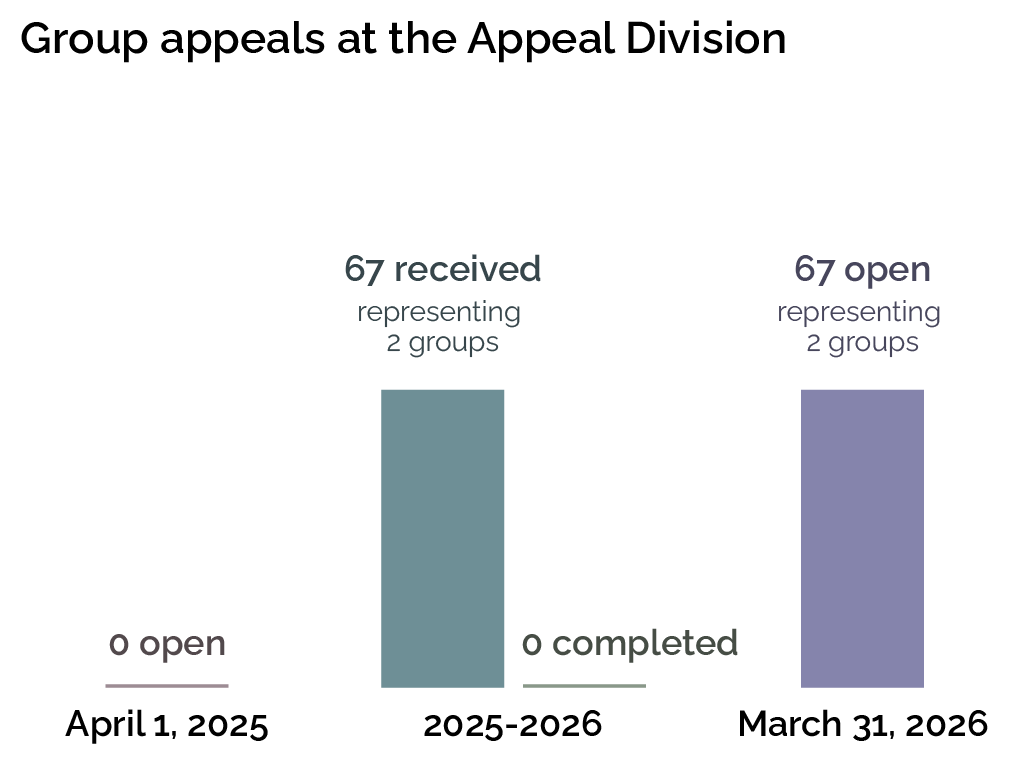
Group appeals usually involve a single employment situation that affects many people. We track these appeals separately because they don’t represent typical appeal timelines. The volume of appeals may be high within a group, but there’s only one hearing for the group and usually only one decision.
Text version
Group appeals at the General Division. On April 1, 2025, there were 94 open appeals, representing 3 groups. In 2025 to 2026, we received 65 group appeals, representing 5 groups. In 2025 to 2026, we completed 117 group appeals, representing 5 groups. On March 31, 2026, there were 42 open group appeals, representing 3 groups.
Text version
Group appeals at the Appeal Division. On April 1, 2025, there were 0 open group appeals. In 2025 to 2026, we received 67 group appeals, representing 2 groups. In 2025 to 2026, we completed 0 group appeals. On March 31, 2026, there were 67 group appeals, representing 2 groups.